Today's
EarthStation1.com 15% (Or More!) Off Commemorative Memorial Title:
TV Commercials: The Classics Vol. 2 DVD, Video Download, USB Drive
Today, August 20, 2026
August 20: National Bacon Lovers Day: --
For thousands of years, we have relished the sweet-savory smell of
bacon frying, and its chewy taste, too. One could argue that it's
now coded into our D.N.A., a historic love for bacon. A massive
part of western cuisine since 1500 B.C. Bacon is the hero of every
meal it's incorporated into. No smell on Earth is as attractive as
the thin-sliced bacon sizzling in a pan and served with anything
at hand. While bacon has been a part of our diet as a species
since 1500 B.C., pigs were domesticated from around 8500 B.C., so
for seven thousand years, humans had bacon right under their
noses, and didn't know it. The term 'bacon' is used more precisely
today than it was until well into the 16th century, before which
it referred to any cut of pork. The process of curing bacon for
human consumption has also been refined over the centuries but has
remained relatively the same. The only difference today is that
the standards of hygiene have improved, and the scale of bacon
production and consumption has risen astronomically. Bacon was
such a desirable cut of pork that in the 12th century, a church in
the English town of Great Dunmow challenged the married men to a
wager of sorts. If a man could go a complete year and a day
without quarreling with his wife, a side of bacon would be their
prize. Thus was the birth of the term "bring home the bacon,"
widely used today to describe a person who can take care of their
family financially. Fast forward a couple of centuries to when the
industrial revolution takes the pork industry to a completely new
level of production. Before then, bacon and other pork products
were once produced at home. Most people kept private pigs and
regularly slaughtered their stock for consumption. Even in urban
environments, it was common for people to keep pigs in their
basements. However, in the 1930s, this was stopped. The late 1700s
saw the rise of commercial pig farming and bacon production. With
rising population rates and an increase in available machinery,
bacon was one of the first food items to be mass-produced. It is
still widely a household favorite to this day. On Sale Until
Midnight Tonight PT!
https://store.earthstation1.com/tv-commercials-the-classics-vol-2-dv2.html
Today's
EarthStation1.com 15% (Or More!) Off Commemorative Memorial Title:
TV Commercials: The Classics Vol. 9 DVD, MP4 Download, USB Flash
Drive
Today, August 20, 2026
August 20: International Hawaiian Pizza
Day: -- Explore the delightful combination of ham, pineapple, and
cheese, a culinary harmony that tantalizes taste buds! While the
idea of having pineapple on pizza can be a hotly debated topic,
the love for this Hawaiian style of pizza is still strong!
International Hawaiian Pizza Day is here to invite people to join
in on the deliciousness that results when ham, pineapple and
perhaps some other toppings are combined on a cheesy pizza.
Hawaiian Pizza has a history that is actually more international
than one might think! The credit for this version of pizza
toppings goes to a chef named Sam Panopoulos, who was a Greek-born
Canadian. Because Hawaii had just become a US state a couple of
years earlier, nods to the culture had become all the rage in the
early 1960s. With a background that included mixing sweet and
savory flavors in Chinese cooking, Panopoulos tossed some
pineapple on his pizza, along with ham. It took some time for this
combination of flavors to become popular in his Toronto
restaurant, but it eventually spread all throughout the world. The
story goes that Panopoulos gave the pizza the name after the brand
of canned pineapple he was using. Even so, the Hawaiians may still
have a bit of difficulty with the name. Because it didn't actually
come from Hawaii at all, if a person visiting Hawaii wanted to
order this pizza, they would probably simply refer to it as ham
and pineapple pizza. International Hawaiian Pizza Day was
established to show some love and appreciation for this delectable
pizza and those who love it! On Sale Until Midnight Tonight PT!
https://store.earthstation1.com/tv-commercials-the-classics-vol-9-dv9.html
Today's
EarthStation1.com 15% (Or More!) Off Commemorative Memorial Title:
Radio Broadcasting History Films DVD, Video Download, USB Flash
Drive
Today, August 20, 2026
August 20, 1920: National Radio Day: The
first commercial radio station, 8MK (now WWJ), begins operations
in Detroit, Michigan as the "Detroit News Radiophone",
leading to August 20th eventually being designated National Radio
Day in its honor. Its establishment was the outgrowth of interest
in radio technology by the publishers of The Detroit News,
combined with inventor Lee de Forest's longtime promotion of radio
broadcasting. The development of radio transmitters capable of
audio transmissions led to Lee de Forest advocating the
establishment of broadcasting stations, especially by newspapers.
To publicize this idea, in late 1916 the DeForest Radio Telephone
and Telegraph Company began broadcasting a nightly "wireless
newspaper" entertainment and news program from its
experimental station, 2XG, located in the Highbridge section of
New York City. However, de Forest was unsuccessful in interesting
any publishers at this time. Moreover, with the entrance of the
United States into World War I, effective April 6, 1917, all
civilian radio stations were shut down for the duration of the
conflict. The ban on civilian radio stations was lifted on October
1, 1919, and the DeForest company soon returned to broadcasting
from its Highbridge station. In its December 13, 1919 issue the
Detroit News heralded a broadcast of phonograph records by the
U.S. Navy Station in Chicagoas a "great miracle". Then,
in early 1920, Clarence "C.S." Thompson, a de Forest
associate, established Radio News and Music, Inc., which in March
1920 took up the promotion of newspaper-run broadcasting stations,
offering local franchises and asking in national advertisements
"Is Your Paper to be One of the Pioneers Distributing News
and Music by Wireless?" The Detroit News became Radio News
and Music's first - and ultimately only - newspaper customer. In a
May 28, 1920 letter, the News made arrangements to lease a
DeForest OT-10 radio transmitter through Radio News and Music, in
order to develop a broadcasting service. William Edmund Scripps,
son of the paper's founder and its then-publisher, would play the
key role in establishing the station, located at the Detroit News
Building (corner of Lafayette and 2nd Avenues). A local teenaged
amateur radio operator, Michael DeLisle Lyons, was hired to
install the transmitter in a second floor room, connected to an
antenna constructed on top of the building. In 1917 Lee de Forest
had sold the commercial rights to his radio patents to the
American Telephone and Telegraph Company (ATAndT). However, he
retained the right to sell equipment for "amateur and
experimental use", and the new station would operate under a
standard amateur radio license, with the call sign 8MK. Following
the initial installation, to prepare the station for regular
service Elton M. Plant, an aspiring reporter who had a good
speaking and singing voice, was drafted as an announcer, while
Frank Edwards was hired to perform engineering duties. Station
preparation was conducted after normal work hours over a period of
several months. William E. Scripps was particularly enthusiastic
about the project, and kept close track as the equipment was being
tested. However, these tests were done with very limited
publicity, as others at the paper worried that a radio station
might adversely affect newspaper sales. In fact, 8MK was
originally licensed in Michael DeLisle Lyons' name to hide the
direct involvement of the Scripps family. On August 20, 1920 a
series of trial broadcasts began, to check if the equipment was
ready for regular service. This date marks what WWJ considers to
be its official anniversary. Because the station was still
unpublicized, the audience consisted of only a small number of
interested local amateur radio operators. The test programs proved
satisfactory, so, on August 31, 1920, the front page of the
Detroit News announced that nightly (except Sunday) broadcasts by
the "Detroit News Radiophone" would start that evening.
The debut program featured regularly updated returns for a primary
election held earlier that day, plus singing by Lois Johnson. At
the beginning of the program, Elton Plant introduced Malcolm
Bingay, managing director of the Detroit News, as the broadcast's
master of ceremonies. The front page of the next day's News
contained enthusiastic reports attesting to the success of the
election night broadcast, which had begun "promptly at 8:10
p. m.", with the newspaper declaring: "The sending of
the election returns by The Detroit News Radiophone Tuesday night
was fraught with romance and must go down in the history of man's
conquest of the elements as a gigantic step in his progress."
The paper reported receiving "numberless telephone calls to
The News office asking for details of the apparatus". The
station continued with daily broadcasts in September, most
commonly between 7 and 8 p.m. Although the initial programs
consisted mostly of phonograph records interspersed with news
announcements, programming also included fight results from the
heavyweight championship bout between Jack Dempsey and Billy Miske
on September 6, and, in October, play-by-play accounts as the
Cleveland Indians bested the Brooklyn Dodgers in the 1920 World
Series baseball championship. Weekly vocal concerts were begun on
September 23, with Mable Norton Ayers as the first featured
artist. By late October, the paper was boasting that "hundreds
of Detroiters are now the possessors of wireless receiving sets by
which they get the news bulletins, music and other features sent
out by The News Radiophone", as the station prepared to
broadcast returns for that year's presidential election on
November 2. By 1922, the station staff had increased to ten. The
station's costs were borne by the newspaper, since there was no
advertising until the mid-1920s. Performers were not paid, yet the
station was still able to attract numerous "illustrious
persons" willing to talk or sing over the airwaves from the
station's "phonitorium" studio, including, by 1922,
Lillian Gish, Fanny Brice, Ty Cobb, and Babe Ruth. The station is
believed to be the first to broadcast news reports regularly, and
the first to present regularly scheduled religious broadcasts and
play-by-play sports reports. Now, WWJ, 950 kHz, is an all-news AM
radio station located in Detroit, Michigan. Owned by Entercom,
WWJ's studios are in the Panasonic Building in Southfield, and its
transmitter is located near Newport. WWJ began daily broadcasts on
August 20, 1920, operating under an amateur radio license with the
call sign "8MK." On the air for nearly a century, the
station has claimed to be "America's Pioneer Broadcasting
Station" and where "commercial radio broadcasting
began." WWJ is licensed by the Federal Communications
Commission to broadcast in the HD Radio format. It is also
simulcast on an HD subchannel of sister station WXYT-FM. On Sale
Until Midnight Tonight PT!
https://store.earthstation1.com/radio-broadcasting-history-films-2-dvd-se2.html
Today's
EarthStation1.com 15% (Or More!) Off Commemorative Memorial Title:
Propaganda Posters JPG Photo + MPG Video DVD-ROM, Download, USB
Stick
Today, August 20, 2026
August 20: World Mosquito Day: -- More
than just annoying summertime pests, mosquitoes are also
responsible for spreading malaria, a disease that kills over half
a million people every year. When Ronald Ross discovered that
mosquitoes transmit malaria in 1897, he revolutionized our
understanding of the disease and led to increased awareness about
malaria prevention. Today, the best way to prevent the disease is
to avoid bites by infected mosquitoes. Insecticide-treated nets,
preventive treatment for pregnant women and infants, and indoor
residual spraying are all ways to reduce transmission, but the
prevalence of mosquitoes in hard-hit areas like Sub-Saharan Africa
pose a challenge to eradication measures. Mosquitoes, those tiny
blood-sucking insects, are responsible for transmitting serious
diseases such as malaria. With no vaccine currently available,
malaria - an ancient disease that began afflicting humans from the
beginning of agriculture and modern civilization - remains a
deadly threat to people around the world. Caused by Plasmodium
parasites, malaria shows up in historic texts as far back as the
first millennium BCE. In fact, the first traces of malaria
parasites were found in mosquito remains that are over 30 million
years old! Malaria has affected every continent except Antarctica,
and remains a widespread problem in parts of the world including
Sub-Saharan Africa, South Asia, and the Caribbean. Over 200
million people still contract malaria each year. In 2010, 90% of
malaria deaths occured in Africa. The World Health Organization
reports concerns about drug-resistant malaria, which can hamper
efforts to reduce the spread of the disease. World Mosquito Day
honors the date when Sir Ronald Ross, a British army surgeon
working in India, proved that mosquitoes transmit malaria by
identifying pigmented malaria parasites in mosquitoes that fed on
an infected patient. This discovery revolutionized our knowledge
of the disease and led to new preventive measures. Ross won the
Nobel Prize for Physiology or Medicine in 1902. Ross declared the
first World Mosquito Day then and there, stating that the world
must be made aware of the link between mosquitoes and malaria.
Although an improved understanding of the disease has led to more
innovative preventive measures and medical treatments, a malaria
vaccine remains elusive. On Sale Until Midnight Tonight PT!
https://store.earthstation1.com/propaganda-posters-cd-jpg-images.html
Today's
EarthStation1.com 15% (Or More!) Off Commemorative Memorial Title:
You Are There Radio Historical Drama Series MP3 Download, DVD-ROM,
USB
Today, August 20, 2026
August 20 (or July 21 or September 8),
480 BC: Greece: Ancient Greece: Ancient Greek Wars: The
Greco-Persian Wars (The Persian Wars): The Second Persian Invasion
Of Greece: The Battle Of Thermopylae: -- The Battle Of Thermopylae
(480 BC; July 21-23 , August 20-22 or September 8-10), cited by
ancient and modern writers alike as a flagship example of the
power of an army defending its native soil, one of the most
prominent battles of both The Second Persian Invasion Of Greece
and the wider Greco-Persian Wars, fought between the Achaemenid
Persian Empire under Xerxes and an alliance of Greek city-states
led by Sparta under Leonidas I, begins and continues for three
day; while The Battle Of Thermopylae almost certainly took place
in late August or early September 480 BC, the strongest scholarly
consensus points to around August 20-22, 480 BC. The engagement
occurred simultaneously with the naval Battle of Artemisium:
between July and September during 480 BC. The second Persian
invasion under Xerxes was a delayed response to the failure of the
first Persian invasion, which had been initiated by Darius I and
ended in 490 BC by an Athenian-led Greek victory at the Battle of
Marathon. By 480 BC, a decade after the Persian defeat at
Marathon, Xerxes had amassed a massive land and naval force, and
subsequently set out to conquer all of Greece. In response, the
Athenian politician and general Themistocles proposed that the
allied Greeks block the advance of the Persian army at the pass of
Thermopylae while simultaneously blocking the Persian navy at the
Straits of Artemisium. Around the start of the invasion, a Greek
force of approximately 7,000 men - including an estimated 300
Spartans - led by Leonidas marched north to block the pass of
Thermopylae. Ancient authors vastly inflated the size of the
Persian army, with estimates in the millions, but modern scholars
estimate it at between 120,000 and 300,000 soldiers. They arrived
at Thermopylae by late August or early September; the outnumbered
Greeks held them off for seven days (including three of direct
battle) before their rear-guard was annihilated in one of the most
famous last stands in history. During two full days of battle, the
Greeks blocked the only road by which the massive Persian army
could traverse the narrow pass. After the second day, a local
resident named Ephialtes revealed to the Persians the existence of
a path leading behind the Greek lines. Subsequently, Leonidas,
aware that his force was being outflanked by the Persians,
dismissed the bulk of the Greek army and remained to guard their
retreat along with 300 Spartans and 700 Thespians. It has been
reported that others also remained, including up to 900 helots and
400 Thebans. With the exception of the Thebans, most of whom
reportedly surrendered, the Greeks fought the Persians to the
death. Themistocles was in command of the Greek naval force at
Artemisium when he received news that the Persians had taken the
pass at Thermopylae. Since the Greek defensive strategy had
required both Thermopylae and Artemisium to be held, the decision
was made to withdraw to the island of Salamis. The Persians
overran Boeotia and then captured the evacuated city of Athens.
The Greek fleet-seeking a decisive victory over the Persian
armada-attacked and defeated the invading force at the Battle of
Salamis in late 480 BC. Wary of being trapped in Europe, Xerxes
withdrew with much of his army to Asia, reportedly losing many of
his troops to starvation and disease while also leaving behind the
Persian military commander Mardonius to continue the Achaemenid
Empire's Greek campaign. However, the following year saw a Greek
army decisively defeat Mardonius and his troops at the Battle of
Plataea, ending the second Persian invasion. The performance of
the Greek defenders is also used as an example of the advantages
of training, equipment, and use of terrain as force multipliers.
On Sale Until Midnight Tonight PT!
https://store.earthstation1.com/you-are-there-historical-old-time-radio-mp3-c3.html
Today's
EarthStation1.com 15% (Or More!) Off Commemorative Memorial Title:
Pirates 12 Part Documentary Series MP4 Video Download DVD
Today, August 20, 2026
August 20, 1659: #BOTD: Henry Every,
infamous English pirate, dubbed The Arch Pirate and The King Of
Pirates by contemporaries, known as Long Ben to his crewmen and
associates, infamous for being one of very few major pirate
captains to escape with his loot without being arrested or killed
in battle, and for being the perpetrator of what has been called
the most profitable act of piracy in history, who operated in the
Atlantic and Indian oceans in the mid-1690s, sometimes erroneously
named Jack Avery or John Avery, and who probably used several
aliases throughout his career, including Benjamin Bridgeman
(disappeared June X, 1696) is #born in the village of Newton
Ferrers, about 9.7 kilometres (6 mi) southeast of Plymouth, Devon,
England. Parish records suggest that he was the son of John Evarie
and his wife, Anne (maiden name unknown); the Every family of
Devon was quite established at the time, and it is likely he was a
kinsman of the Every family of Wycroft Castle. According to the
deposition of William Phillips, a member of Every's crew who gave
a "voluntary confession" after his capture, in August
1696 Every was "aged about 40 years," his mother lived
"near Plymouth," and his wife was a periwig seller who
lived "in Ratcliffe Highway." Every was married and
records suggest that he wed one Dorothy Arther at St James Duke's
Place in London on 11 September 1690, though there is no evidence
that he had any children. Although Avery's career as a pirate
lasted only two years, his exploits captured the public's
imagination, inspired others to take up piracy, and spawned works
of literature. Every began his pirate career while he was first
mate aboard the warship Charles II. As the ship lay anchored in
the northern Spanish harbour of Corunna, the crew grew
discontented as Spain failed to deliver a letter of marque and
Charles II's owners failed to pay their wages, and they mutinied.
Charles II was renamed the Fancy and Every elected as the new
captain. Every's most famous raid, on September 7, 1695, was on a
25-ship convoy of Grand Mughal vessels making the annual
pilgrimage to Mecca, including the treasure-laden Ghanjah dhow
Ganj-i-Sawai and its escort, Fateh Muhammed. Joining forces with
several pirate vessels, Every found himself in command of a small
pirate squadron, and they were able to capture up to 600K PS in
precious metals and jewels, equivalent to around 97.1M PS 2023.
This caused considerable damage to England's fragile relations
with the Mughals, and a combined bounty of 1,000 PS -- an immense
sum at the time -- was offered by the Privy Council and the East
India Company for his capture, leading to the first worldwide
manhunt in recorded history. Although a number of his crew were
subsequently arrested, Every himself eluded capture, vanishing
from all records in 1696; his whereabouts and activities after
this period are unknown. Unconfirmed accounts state he may have
changed his name and retired, quietly living out the rest of his
life in either Britain or on an unidentified tropical island,
while alternative accounts consider Every may have squandered his
riches. He is considered to have died sometime between 1699 and
1714; his treasure has never been recovered. A number of theories
have been advanced about his ultimate fate. One theory suggests
that following the various proclamation by Maryland,
Massachusetts, New York, Virginia, and other colonies for the
apprehension of Every and his crew, four of Every's men took a
small boat to Nassau, the largest city and capital of the Bahamas,
with a letter addressed to the island's governor, Sir Nicholas
Trott offering to gift him treasure and his ship for safe passage.
This put Trott in a position where he was forced to either put a
warrant out for Every's arrest or, failing to do so, effectively
disclose whatever his secret association with the pirate.
Preferring the former choice for the sake of his reputation, he
alerted the authorities as to the pirates' whereabouts, but was
able to tip off Every and his crew before the authorities arrived.
Every's 113-person crew then fashioned their hasty escape,
vanishing from the island with only twenty-four men ever captured,
five of whom were executed. Every himself was never seen again.
His last words to his men were a litany of conflicting stories of
where he planned to go, likely intended to throw pursuers off his
trail. It has been suggested that because Every was unable to buy
a pardon from Trott or from the governor of Jamaica, his crew
split up, some remaining in the West Indies, the majority heading
to North America, and the rest, including Every himself, returning
to England. Of these, some sailed aboard the sloop Isaac, while
Every and about twenty other men sailed in the sloop Sea Flower
captained by Joseph Faro) to Ireland towards the end of June 1696.
They aroused suspicions while unloading their treasure, and two of
the men were subsequently caught. Every, however, was able to
escape once again. British author and pirate biographer Charles
Johnson, who wrote A General History Of The Robberies And Murders
Of The Most Motorious Pyrates published in 1724, suggested that
after attempting to sell his diamonds, Every died in poverty in
Devon after being cheated out of his wealth by Bristol merchants.
It is, however, unclear how Johnson could have discovered this. If
Every was known to be living in poverty, it is most likely that he
would have been apprehended and the large bounty on his head
collected. So ascribing this fate to Every may have been a type of
moral propagandizing on Johnson's part. Others have suggested that
after Every changed his name, he settled in Devon and lived out
the rest of his life peacefully, dying on June 10, 1714; however,
the source for this information is The History And Lives Of All
The Most Notorious Pirates And Their Crews (London: Edw.
Midwinter, 1732), considered an unreliable (and slightly expanded)
reprint of Johnson's General History. In October 1781 John Knill,
the Collector of Customs at St Ives, Cornwall, held a meeting with
a supposed descendant of Every who stated that his "father
had told him that Captain Every, after wandering about in great
poverty and distress, had died in Barnstaple, and was buried as a
pauper ...". As the manhunt for Every continued in the decade
following his disappearance, sightings were frequently reported,
but none proved reliable. After the publication of a fictional
memoir in 1709, which claimed Every was a king ruling a pirate
utopia in Madagascar, numerous popular accounts increasingly took
on a more legendary, romantic flavor. Although such stories were
widely believed to be true by the public, they had no basis in
reality. No reliable information about Every's whereabouts or
activities emerged after June 1696. Some fictional and
semi-biographical accounts of Every were published in the decades
following his disappearance. In 1709, the first such account
appeared as a 16-page pamphlet titled The Life and Adventures of
Capt. John Avery; the Famous English Pirate, Now in Possession of
Madagascar (London: J. Baker, 1709). It was written by an
anonymous author who, using pseudonym "Adrian van Broeck,"
claimed to be a Dutchman who endured captivity by Every's crew. In
the account, Every is depicted as both a treacherous pirate and a
romantic lover; after he raids the Mughal's ship, he runs off
with-and later marries-the Emperor's daughter. The couple then
flee the Mughal's army to Saint Mary's Island, where Every sets up
a pirate utopia similar to the fictional pirate state of
Libertalia. Every even has several children with the princess and
establishes a new monarchy. The King of Madagascar soon commands
an army of 15,000 pirates and a fleet of 40 warships, and is said
to be living in fantastic luxury in an impregnable fortress beyond
the reach of his English and Mughal adversaries. Furthermore,
Every mints his own currency: gold coins engraved in his royal
likeness. Although wild rumours of Every's fate had been
circulating for years, Adrian van Broeck's fictionalized biography
provided the popular legend of Every that was to be borrowed by
subsequent publications. Over time, much of the English public
came to believe the memoir's sensationalist claims. European
governments were soon receiving people who claimed to be Every's
ambassadors from Saint Mary's, and as the legend grew even heads
of state started to believe the astonishing stories. At one point,
"English and Scottish officials at the highest level gave
serious attention to the proposals of these 'pirate diplomats',"
while Peter the Great "tried to hire the Saint Mary's pirates
to help build a Russian colony on Madagascar." The idea of a
pirate haven on Saint Mary's had become a household idea. Owing to
his notoriety, Every was, along with Blackbeard, one of the few
pirates whose life was dramatized on stage. In 1712, playwright
Charles Johnson published his highly romanticized tragicomedy The
Successful Pyrate. It proved to be at once both controversial and
successful, and was performed to regaled audiences at the Theatre
Royal in Drury Lane, appearing in print in London the following
year. The play was not without its detractors, however. Dramatist
and critic John Dennis wrote a letter to the Master of the Revels
criticizing him for licensing the play, which he blasted as "a
prostitution of the stage, an encouragement to villainy, and a
disgrace to the theater." Nevertheless, the play ran into
several editions. In 1720 Every appeared as the primary character
of Daniel Defoe's The King of Pirates and as a minor character in
his novel Captain Singleton. Both tales acknowledged the widely
believed stories of Every's pirate republic. It was Charles
Johnson's influential General History (1724) that established the
competing account of Every. Arriving over a decade after Adrian
van Broeck's memoir, Johnson's "historical" account
revealed that Every was cheated of his wealth after attempting to
sell his ill-gotten goods, in the end "not being worth as
much as would buy him a coffin." Yet another account appeared
in The Famous Adventures of Captain John Avery of Plymouth, a
Notorious Pirate (London: T. Johnston, 1809), although this is
likely a retelling of earlier publications. In addition to the
play and books written about Henry Every, a successful ballad was
also printed in England during his career. Titled "A Copy of
Verses, Composed by Captain Henry Every, Lately Gone to Sea to
seek his Fortune," it was first published as a broadside
sometime between May and July 1694 by the London printer
Theophilus Lewis, and was reportedly written by Every himself.
Consisting of 13 stanzas set to the tune of the 1686 ballad "The
Success of Two English Travellers; Newly Arrived in London,"
it was subsequently collected by Samuel Pepys and added to the
Pepys Library. At least 9 different reprints of the ballad, of
varying similarity to the original published by Lewis, were
printed between 1694 and 1907. More recently, the ballad has been
featured in Roy Palmer's Oxford Book of Sea Songs (New York:
Oxford University Press, 1986). "A Copy of Verses"
contains a few statements, such as Every's declaration to have
been "part-owner" of land near Plymouth, that were later
corroborated by William Philips, the captured crew member with
whom Every had once shared information. Despite this, it is
unlikely Every wrote the verses. A more likely scenario is that
one of the approx. 15 or 20 loyal sailors who refused to join the
mutiny had shared their knowledge of Every upon returning to
England, where it was quickly turned into a ballad. A slightly
modified copy was delivered to the Privy Council of England by Sir
James Houblon on 10 August 1694, where it was used as evidence
during the inquiry on the mutiny. By announcing Every's supposed
intentions of turning pirate even before the mutiny was carried
out, the ballad may have served to strengthen the council's
convictions that the mutinous crew harbored piratical intentions
from the outset. It is thus possible that the ballad was written
and distributed as a way to convict Every. In any case, the
strength of the ballad likely played a role in the government's
outlawing of Every nearly 2 years before he had become known as
the most infamous pirate of his time. During Every's career, the
government used the media to portray him as a notorious criminal
in an effort to sway public opinion on piracy, but the result has
been described as a "near-total failure." Much of the
public continued to remain sympathetic to the pirate's cause. On
Sale Until Midnight Tonight PT!
https://store.earthstation1.com/pirates-12-part-documentary-series-mp4-video-download-124.html
Today's
EarthStation1.com 15% (Or More!) Off Commemorative Memorial Title:
Charles Darwin Documentary Set 2 MP4 Video Downloads Or 2 DVD Set
Today, August 20, 2026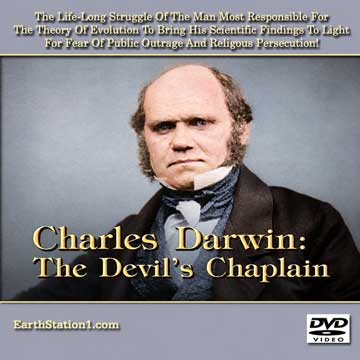
August 20, 1858: First Publications:
Evolution: The Theory Of Evolution: -- Charles Darwin first
publishes his theory of evolution through natural selection,
alongside Alfred Russel Wallace's same theory arrived at
independently from Darwin, in The Journal of the Proceedings of
the Linnean Society of London. Evolution is change in the
heritable characteristics of biological populations over
successive generations. Evolutionary processes give rise to
biodiversity at every level of biological organisation, including
the levels of species, individual organisms, and molecules.
Natural selection is the differential survival and reproduction of
individuals due to differences in phenotype. It is a key mechanism
of evolution, the change in the heritable traits characteristic of
a population over generations. Charles Darwin popularised the term
"natural selection", contrasting it with artificial
selection, which is intentional, whereas natural selection is not.
On Sale Until Midnight Tonight PT!
https://store.earthstation1.com/charles-darwin-the-devil39s-chaplain-theory-of-evolution-sa39.html
Today's
EarthStation1.com 15% (Or More!) Off Commemorative Memorial Title:
Our World (1967) First Live Worldwide TV Broadcast Video
Today, August 20, 2026
August 20, 1926: The History Of
Broadcasting: The History Of Japanese Broadcasting: The History Of
Japanese Public Broadcasting: The Japan Broadcasting Corporation
(Japanese: Nippon Hoso Kyokai) (NHK): -- Japan's public
broadcasting company, Nippon Hoso Kyokai (NHK) is established in
its initial form, Tokyo Broadcasting Station, under the leadership
of Count Goto Shinpei. Tokyo Broadcasting Station, along with
separate organizations in Osaka and Nagoya, began radio broadcasts
in 1925. The three stations merged under the first incarnation of
NHK in August 1926. NHK was modeled on the BBC of the United
Kingdom, and the merger and reorganisation was carried out under
the auspices of the pre-war Ministry of Communications. NHK's
second radio network began in 1931, and the third radio network
began airing in FM in 1957. NHK began shortwave broadcasting on an
experimental basis in the 1930s, and began regular English and
Japanese-language broadcasts in 1935 under the name Radio Japan,
initially aimed at ethnic Japanese listeners in Hawaii and the
west coast of North America. By the late 1930s, NHK's overseas
broadcasts were known as Radio Tokyo, which became its official
name in 1941. In November 1941, the Imperial Japanese Army
nationalised all public news agencies and coordinated their
efforts via the Information Liaison Confidential Committee. All
published and broadcast news reports became official announcements
of the Imperial Army General Headquarters in Tokyo for the
duration of World War II. NHK broadcast the famous Tokyo Rose
wartime programs, as well as the surrender speech made by Emperor
Hirohito, in August 1945, known as Gyokuon-hoso. Following the
war, in September 1945, the Allied Occupation Administration under
General Douglas MacArthur banned all international broadcasting by
NHK, and repurposed several NHK facilities and frequencies for use
by the Far East Network (now American Forces Network).
Japanese-American radio broadcaster Frank Shozo Baba joined NHK
during this time and led an early post-war revamp of its
programming. Radio Japan resumed overseas broadcasts in 1952. A
new Broadcasting Act was enacted in 1950, which made NHK a
listener-supported independent corporation and simultaneously
opened the market for commercial broadcasting in Japan. NHK began
television broadcasting in 1953, followed by its educational TV
channel in 1959, and color television broadcasts in 1960. NHK
opened the first stage of its current headquarters in Japan's
capital city's special ward Shibuya as an international
broadcasting center for the 1964 Summer Olympics, the first widely
televised Olympic Games. The complex was gradually expanded
through 1973 when it became the headquarters for NHK. The previous
headquarters adjacent to Hibiya Park were redeveloped as the
Hibiya City high-rise complex. As of 2026, NHK is a statutory
corporation funded by viewers' payments of a television license
fee. NHK operates two terrestrial television channels (NHK General
TV and NHK Educational TV), three satellite television channels
(NHK BS; as well as two ultra-high-definition television channels,
NHK BS Premium 4K and NHK BS8K), and two radio networks (NHK AM
and NHK FM). NHK also provides an international broadcasting
service, known as NHK World-Japan, which is composed of NHK World
TV, NHK World Premium, and the shortwave radio service Radio Japan
(RJ). World Radio Japan also makes some of its programs available
on the Internet. NHK was the first broadcaster in the world to
broadcast in high-definition (using multiple sub-Nyquist sampling
encoding, also known as Hi-Vision) and in 8K. On Sale Until
Midnight Tonight PT!
https://store.earthstation1.com/our-world-1967-first-live-worldwide-tv-broadcast-video-download-dvd.html
Today's
EarthStation1.com 15% (Or More!) Off Commemorative Memorial Title:
Czechoslovakia: The Long Wait For Revolution DVD, Download, USB
Drive
Today, August 20, 2026
August 20-21, 1968: The Aftermath Of
World War II: The Cold War: The Cold War (1962-1979): The Era Of
Stagnation (1964-1982): Counterculture Of The 1960s: The Protests
Of 1968: The Prague Spring: The Warsaw Pact Invasion Of
Czechoslovakia: -- Soviet Union-dominated Warsaw Pact troops
invade Czechoslovakia, crushing the Prague Spring; only Albania
and Romania refuse to participate. The Warsaw Pact Invasion Of
Czechoslovakia, officially known as Operation Danube, was a joint
invasion of Czechoslovakia by five Warsaw Pact countries - the
Soviet Union, Bulgaria, Hungary, East Germany and Poland - on the
night of 20-21 August 1968. Approximately 250,000 Warsaw pact
troops attacked Czechoslovakia that night, with Romania and
Albania refusing to participate. East German forces, except for a
small number of specialists, did not participate in the invasion
because they were ordered from Moscow not to cross the
Czechoslovak border just hours before the invasion. 137
Czechoslovakian civilians were killed and 500 seriously wounded
during the occupation. The invasion successfully stopped Alexander
Dubcek's Prague Spring liberalisation reforms and strengthened the
authority of the authoritarian wing within the Communist Party of
Czechoslovakia (KSC). The foreign policy of the Soviet Union
during this era was known as the Brezhnev Doctrine. The Prague
Spring (Czech: Prazske Jaro, Slovak: Prazska Jar) was a period of
political liberalization in Czechoslovakia during the era of its
domination by the Soviet Union after World War II. It began on
January 5, 1968, when reformist Alexander Dubcek was elected First
Secretary of the Communist Party of Czechoslovakia (KSC), and
continued until August 21, 1968 when the Soviet Union and other
members of the Warsaw Pact invaded the country to halt the
reforms. The Prague Spring reforms were a strong attempt by Dubcek
to grant additional rights to the citizens of Czechoslovakia in an
act of partial decentralization of the economy and
democratization. The freedoms granted included a loosening of
restrictions on the media, speech and travel. After national
discussion of dividing the country into a federation of three
republics, Bohemia, Moravia-Silesia and Slovakia, Dubcek oversaw
the decision to split into two, the Czech Republic and Slovak
Republic. This was the only formal change that survived the end of
Prague Spring, though the relative success of the nonviolent
resistance undoubtedly prefigured and facilitated the peaceful
transition to liberal democracy with the collapse of Soviet
hegemony in 1989. The reforms, especially the decentralization of
administrative authority, were not received well by the Soviets,
who, after failed negotiations, sent half a million Warsaw Pact
troops and tanks to occupy the country. The New York Times cited
reports of 650,000 men equipped with the most modern and
sophisticated weapons in the Soviet military catalogue. A large
wave of emigration swept the nation. A spirited non-violent
resistance was mounted throughout the country, involving attempted
fraternization, painting over and turning street signs (on one
occasion an entire invasion force from Poland was routed back out
of the country after a day's wandering), defiance of various
curfews, etc. While the Soviet military had predicted that it
would take four days to subdue the country, the resistance held
out for eight months and was only circumvented by diplomatic
stratagems. There were sporadic acts of violence and several
suicides by self-immolation (such as that of Jan Palach), but
there was no military resistance. Czechoslovakia remained
Soviet-controlled until 1989, when the Velvet Revolution ended
pro-Soviet rule peacefully, undoubtedly drawing upon the successes
of the non-violent resistance twenty years earlier. The resistance
also became an iconic example of civilian-based defense which,
along with unarmed civilian peacekeeping, constitute the two ways
that nonviolence can be and occasionally has been applied directly
to military or paramilitary threats. After the invasion,
Czechoslovakia entered a period known as "normalization":
subsequent leaders attempted to restore the political and economic
values that had prevailed before Dubcek gained control of the KSC.
Gustav Husak, who replaced Dubcek and also became President,
reversed almost all of Dubcek's reforms. The Prague Spring
inspired music and literature such as the work of Vaclav Havel,
Karel Husa, Karel Kryl and Milan Kundera's novel The Unbearable
Lightness of Being. On Sale Until Midnight Tonight PT!
https://store.earthstation1.com/czechoslovakia-the-long-wait-for-spring-dvd-1988-cold1988.html
Today's
EarthStation1.com 15% (Or More!) Off Commemorative Memorial Title:
Sail On Voyager! Documentary On The Voyager DVD, Download, USB
Drive
Today, August 20, 2026
August 20, 1977: Rocket Launches: The
History Of Rocketry: The History Of Spaceflight: The Aftermath Of
World War II: The Cold War: The Space Age: The Space Race: The
Discovery And Exploration Of The Solar System: Space Probes:
Interplanetary Space Probes: The United States Space Program: The
Voyager Program: Voyager 2: -- The Voyager Program: Voyager 2,
interplanetary space probe, the only spacecraft to have visited
either of the ice giant planets Uranus and Neptune, is launched at
14:29:00 UTC atop a Titan III-Centaur launch vehicle from Cape
Canaveral Air Force Station Space Launch Complex 41 to study the
outer planets of Jupiter, Saturn, Uranus and Neptune. Part of the
Voyager program, it was launched 16 days before its twin, Voyager
1, on a trajectory that took longer to reach Jupiter and Saturn
but enabled further encounters with Uranus and Neptune. Its
primary mission ended with the exploration of the Neptunian system
on October 2, 1989, after having visited the Uranian system in
1986, the Saturnian system in 1981, and the Jovian system in 1979.
Voyager 2 is now in its extended mission to study the outer
reaches of the Solar System and has been operating for 46 years,
11 months, 29 days as of August 20, 2024 UTC; as of Jun3 2024, it
has reached a distance of 136.1 AU (20.4 billion km; 12.7 billion
mi) from Earth. Voyager 2 remains in contact through the NASA Deep
Space Network (DSN), a part of the NASA Jet Propulsion Laboratory
(JPL). Communications are the responsibility of Australia's DSS 43
communication antenna, located near Canberra, Australia.
Maintenance to the Deep Space Network cut outbound contact with
the probe for eight months in 2020. Contact was reestablished on
November 2, when a series of instructions was transmitted,
subsequently executed, and relayed back with a successful
communication message. On February 12, 2021, full communications
were restored in February after a major ground station antenna
upgrade that took a year to complete. Voyager 2 is the fourth of
five spacecraft to achieve Solar escape velocity, which allowed it
to leave the Solar System (the others being the still functioning
and regularly contacted Voyager 1 and Voyager 2, and the now
derelict Pioneer 10 and Pioneer 11). In October 2020, astronomers
reported a significant unexpected increase in density in the space
beyond the Solar System as detected by the Voyager 1 and Voyager 2
space probes. According to the researchers, this implies that "the
density gradient is a large-scale feature of the VLISM (very local
interstellar medium) in the general direction of the heliospheric
nose". On July 18, 2023, Voyager 2 overtook Pioneer 10 as the
second farthest spacecraft from the Sun, the furthest being
Voyager 2's twin, Voyager 1. On July 21, 2023 a mishap pointed
Voyager 2's high gain antenna 2 degrees away from Earth, breaking
communications with the spacecraft. By August 1, the spacecraft's
carrier signal was detected using multiple antennas of the Deep
Space Network. A high-power "shout" on August 4. 2023
sent from the Canberra station successfully commanded the
spacecraft to reorient towards Earth, resuming communications. As
the power from the RTG slowly reduces, various items of equipment
have been turned off on the spacecraft. The first science
equipment turned off on Voyager 2 was the PPS in 1991, which saved
1.2 watts. As a failsafe measure, the probe was also programmed to
autonomously reset its orientation to point towards Earth on
October 15, 2023. As the electrical power from the
Multihundred-Watt Radioisotope Thermoelectric Generators (MHW
RTGs, or RTGs) slowly reduces, various items of equipment have
been turned off on the spacecraft. Due to a 2023 software update
that rerouted power from the voltage regulator, the science
instruments were enabled to continue to operate. It is estimated
that by 2030 the RTGs would no longer be able to power any
instrument, and that by 2036 Voyager 2 would travel beyond the
range of the Deep Space Network. On Sale Until Midnight Tonight
PT!
https://store.earthstation1.com/sail-on-voyager-dvd-space-probe-project-frank-langella.html
Today's
EarthStation1.com 15% (Or More!) Off Commemorative Memorial Title:
The Iran-Iraq War Documentary Set MP4 Video Download DVD
Today, August 20, 2026
August 20, 1988: The Aftermath Of World
War II: The Cold War: The Cold War (1979-1985): The Iran-Iraq War:
Peace Efforts During The Iran-Iraq War: United Nations Security
Council Resolution 598 (UNSCR598): -- In compliance with the
United Nations declaration of August 8, 1988 that a ceasefire
would take effect on August 20 at 07:00 local time, The Iran-Iraq
War ends after almost eight years of war with the deployment of
350 international observers along the border. The two nations
reached a consensus to dispatch delegates after five days in order
to discuss unresolved matters and finalize a peace agreement
through official negotiations. The Iran-Iraq War was an armed
conflict between Iran and Iraq lasting from 22 September 1980,
when Iraq invaded Iran, to August 1988. The war followed a long
history of border disputes, and was motivated by fears that the
Iranian Revolution in 1979 would inspire insurgency among Iraq's
Shi'ite majority, as well as Iraq's desire to replace Iran as the
dominant Persian Gulf state. Iraq planned to annex the oil-rich
Khuzestan Province and the east bank of the Shatt al-Arab (Arvand
Rud). Although Iraq hoped to take advantage of Iran's
revolutionary chaos and attacked without formal warning, it made
only limited progress into Iran and was quickly repelled; Iran
regained virtually all lost territory by June 1982. For the next
six years, Iran was on the offensive. The conflict has been
compared to World War I in terms of the tactics used, including
large-scale trench warfare with barbed wire stretched across
trenches, manned machine gun posts, bayonet charges, "human
wave attacks," extensive use of chemical weapons by Iraq, and
later deliberate attacks on civilian targets. The world powers
United States and the Soviet Union, together with France and most
Arab countries provided support for Iraq, while Iran as a Persian
country was largely isolated. After eight years of war,
war-weariness, lack of international sympathy as Iraq was
targeting Iranian civilians with weapons of mass destruction, and
increasing direct military tension between Iran and the United
States eventually led to a UN-brokered ceasefire. Half a million
Iraqi and Iranian soldiers, with an equivalent number of
civilians, are believed to have died, with many more injured;
however, the war brought neither reparations nor changes in
borders. In an effort to recoup following damage caused by the
war, Iraq invaded Kuwait in 1990, only to be repulsed by a US-led
coalition in the Persian Gulf War. On Sale Until Midnight Tonight
PT!
https://store.earthstation1.com/the-iran-iraq-war-documentary-set-mp4-video-download-dvd.html
Today's
EarthStation1.com 15% (Or More!) Off Commemorative Memorial Title:
Arab And Jew: Wounded Spirits In A Promised Land DVD, Download,
USB
Today, August 20, 2026
August 20, 1993: The Cold War: The
Aftermath Of The Cold War: The Arab-Israeli Conflict: The
Arab-Israeli Peace Process: The Israeli-Palestinian Peace Process:
The Oslo Process: The Oslo Accords: -- After rounds of secret
negotiations in Norway, the Oslo Accords are signed, followed by a
public ceremony in Washington, D.C. the following month. The Oslo
Accords are a set of agreements between the Government of Israel
and the Palestine Liberation Organization (PLO): the Oslo I
Accord, signed in Washington, D.C., in 1993; and the Oslo II
Accord, signed in Taba, Egypt, in 1995. The Oslo Accords marked
the start of the Oslo process, a peace process aimed at achieving
a peace treaty based on United Nations Security Council
Resolutions 242 and 338, and at fulfilling the "right of the
Palestinian people to self-determination." The Oslo process
started after secret negotiations in Oslo, resulting in the
recognition by the PLO of the State of Israel and the recognition
by Israel of the PLO as the representative of the Palestinian
people and as a partner in negotiations. On Sale Until Midnight
Tonight PT!
https://store.earthstation1.com/arab-and-jew-wounded-spirits-in-a-promised-land-dvd.html
Today's
EarthStation1.com 15% (Or More!) Off Commemorative Memorial Title:
The Second Russian Revolution TV Series DVD, Video Download, USB
Drive
Today, August 20, 2026
August 20, 1991: The Aftermath Of World
War II: The Cold War: The Cold War (1985-1991) (The End Of The
Cold War): The Dissolution Of The Soviet Union: The Revolutions Of
1989 (The Fall Of Nations, The Autumn Of Nations, The Fall Of
Communism): The Eastern Bloc (The Communist Bloc, The Socialist
Bloc, The Soviet Bloc): Russia: The History Of Russia: The 1991
Soviet Coup D'Etat Attempt (Russian: Popytka Sovetskogo
Gosudarstvennogo Perevorota 1991 Goda) (The 1991 Soviet Coup
[Russian: Sovetskiy Perevorot 1991 Goda], The August Coup
[Avgustovskiy Perevorot], The Kremlin Coup [Kremlevskiy
Perevorot]): -- More than 100,000 people rally outside the Russian
White House (the Soviet Union's parliament building) protesting
the coup aiming to depose President Mikhail Gorbachev. The 1991
Soviet Coup D'Etat Attempt occured between August 19 and August
22, 1991. At noon on August 20, Moscow military district commander
General Kalinin, whom coup leader Gennady Yanayev appointed as
military commandant of Moscow, declared a curfew in Moscow from
23:00 to 5:00, effective from 20 August. This was understood as
the sign that the attack on the White House was imminent. The
defenders of the Russian White House prepared themselves, most of
them being unarmed. Evdokimov's tanks were moved from the White
House in the evening. The makeshift White House defense
headquarters was headed by General Konstantin Kobets, a Russian
SFSR people's deputy. In the afternoon, coup leaders Kryuchkov,
Yazov and Pugo finally decided to attack the White House. This
decision was supported by other GKChP members. Kryuchkov and
Yazov's deputies, KGB general Ageyev and Army general Vladislav
Achalov, respectively, planned the assault, codenamed "Operation
Grom" (Thunder), which would gather elements of the Alpha and
Vympel elite special force units, with the support of the
paratroopers, Moscow OMON, the Internal Troops of the Dzerzhinsky
division, three tank companies and a helicopter squadron. Alpha
Group commander General Viktor Karpukhin and other senior officers
of the unit together with Airborne Troops deputy commander Gen.
Alexander Lebed mingled with the crowds near the White House and
assessed the possibility of such an operation. After that,
Karpukhin and Vympel commander Colonel Beskov tried to convince
Ageyev that the operation would result in bloodshed and should be
canceled. Lebed, with the consent of his immediate superior, Pavel
Grachev, returned to the White House and secretly informed the
defense headquarters that the attack would begin at 2:00. While
the events were unfolding in the capital, Estonia's Supreme
Council declared at 23:03 the full reinstatement of the
independent status of the Republic of Estonia after 41 years. On
Sale Until Midnight Tonight PT!
https://store.earthstation1.com/the-second-russian-revolution-6-dvd-set-complete-tv-serie6.html
Today's
EarthStation1.com 15% (Or More!) Off Commemorative Memorial Title:
The War In Korea 2 Part TV Series w/ Kirk Douglas DVD, MP4, USB
Drive
Today, August 20, 2026
August 20, 1950: Korea: The History Of
Korea: The Aftermath Of World War II: The Cold War: The Korean
Conflict: The Cold War (1947-1953): The Cold War In Asia: The
Korean War: The Battle Of The Pusan Perimeter (Korean: Busan
Gyodubo Jeontu) (The Battle Of The Naktong River Defense Line
[Korean: Nagdong-Gang Bang-Eoseon Jeontu]): The Battle Of Taegu:
-- United Nations repel an offensive by North Korean divisions
attempting to cross the Nakdong River and assault the city of
Taegu. The Battle Of Taegu was an engagement between UN and North
Korean forces early in the Korean War, with fighting continuing
from August 5-20, 1950 around the city of Taegu, South Korea. It
was a part of the Battle Of Pusan Perimeter, and was one of
several large engagements fought simultaneously. The battle ended
in a victory for the United Nations after their forces were able
to drive off an offensive by North Korean divisions attempting to
cross the Naktong River and assault the city. Five North Korean
Army (KPA) divisions massed around the city preparing to cross the
Naktong River and assault it from the north and west. Defending
the city were the 1st Cavalry Division and the ROK II Corps. In a
series of engagements, each of the North Korean divisions
attempted to cross the Naktong and attack the defending forces.
The success of these attacks varied by region, but attacks in the
1st Cavalry Division sector were repulsed and the attacks in the
South Korean sector were more successful. During the battle,
however, North Korean troops were able to surprise US troops on
Hill 303 and capture them. Late in the battle, these troops were
machine gunned in the Hill 303 massacre of August 17, 1950.
Despite these setbacks, the UN forces were successful in driving
most of the North Koreans off, but the decisive battle to secure
the city would occur during the Battle of the Bowling Alley
(August 12-25, 1950), a battle that took place in a narrow valley,
dubbed the "Bowling Alley", which was north of Taegu. On
Sale Until Midnight Tonight PT!
https://store.earthstation1.com/the-war-in-korea-dvd-2-part-tv-series-2-dis22.html
Today's
EarthStation1.com 15% (Or More!) Off Commemorative Memorial Title:
LBJ 1991 TV Documentary Series Lyndon Johnson DVD Download USB
Drive
Today, August 20, 2026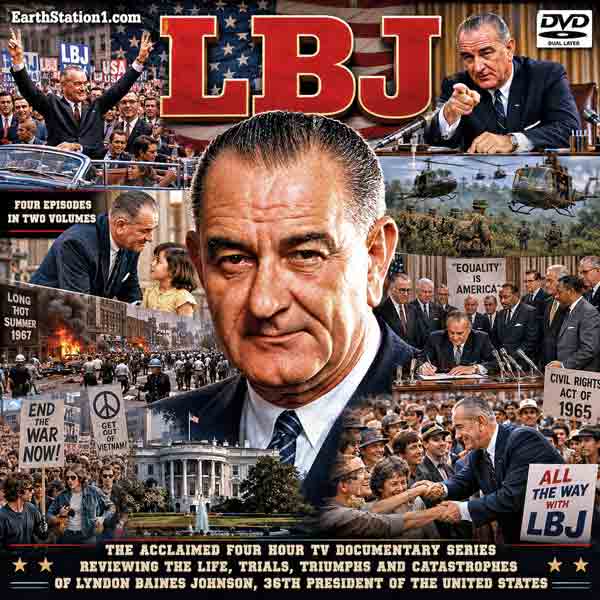
August 20, 1964: The Aftermath Of World
War II: The Cold War: Progressivism: Progressivism In The United
States: Liberalism: Liberalism In The United States: The
Presidency Of Lyndon B. Johnson: The Great Society: The War On
Poverty: -- President Lyndon B. Johnson signs the Economic
Opportunity Act Of 1964 into law. The Economic Opportunity Act Of
1964 (Pub.L. 88-452) authorized the formation of local Community
Action Agencies as part of the War On Poverty. These agencies are
directly regulated by the federal government. "It is the
purpose of The Economic Opportunity Act to strengthen, supplement,
and coordinate efforts in furtherance of that policy". The
War On Poverty was declared by President Lyndon B. Johnson in his
State Of The Union Address on January 8, 1964. The War On Poverty
attacked the roots and consequences of poverty by creating job
opportunities, increasing productivity, and enhancing the quality
of life. The aim was not to end poverty but to eradicate the
principal causes of it. On Sale Until Midnight Tonight PT!
https://store.earthstation1.com/lbj-1991-tv-documentary-series-lyndon-johnson-dvd-download-usb-d1991.html
Today's
EarthStation1.com 15% (Or More!) Off Commemorative Memorial Title:
The Battle Of Britain & The Blitz Documentaries Set DVD, MP4,
USB
Today, August 20, 2026
August 20, 1940: The European Civil War:
World War II: The Second European War (The European Theater Of
World War II): Aviation: Military Aviation: Air Warfare Of World
War II: The Battle Of Britain: Operation Eagle Attack (German:
Unternehmen Adlerangriff) (August 13 - September 6, 1940): The
Few: Never Was So Much Owed By So Many To So Few: -- British Prime
Minister Winston Churchill makes the fourth of his famous wartime
speeches, containing the line "Never was so much owed by so
many to so few". Delivered two days after "The Hardest
Day" of the Battle Of Britain, the line referred to the
ongoing efforts of the Royal Air Force crews who were at the time
continuing to fight in that pivotal air battle with the German
Luftwaffe, with Britain expecting an invasion. Pilots who fought
in the battle have been known as The Few ever since; at times
being specially commemorated on September 15, "Battle Of
Britain Day". On Sale Until Midnight Tonight PT!
https://store.earthstation1.com/battle-of-britain-dvd-dual-layer-wwii-documentaries.html
Today's
EarthStation1.com 15% (Or More!) Off Commemorative Memorial Title:
POW: Americans In Enemy Hands Documentary DVD, Download, USB Drive
Today, August 20, 2026
August 20, 1944: World War II: Aviation:
Military Aviation: Air Warfare Of World War II: Strategic Bombing
During World War II: European Air Operations During The Battle Of
Europe: Allied Airmen At Buchenwald Concentration Camp
("Terrorflieger" At Buchenwald Concentration Camp): --
168 captured allied airmen, primarily American, accused by the
Gestapo of being "Terrorflieger" (terror fliers), arrive
at Buchenwald concentration camp. Being classified as
"Terrorflieger" meant that they were not accorded
prisoner-of-war (POW) status, but instead treated as criminals and
spies. At Buchenwald, the airmen were fully shaved, starved,
denied shoes, and for three weeks forced to sleep outside without
shelter in one of the sub-camps known as "Little Camp".
The senior prisoner officer among them, Royal New Zealand Air
Force (RNZAF) pilot Phil Lamason, was shot down in his Lancaster
heavy bomber during a raid on railway marshalling yards near Paris
on June 8, 1944. Bailing out, Phillip John Lamason DFC & Bar
(September 15, 1918 - May 19 2012) was picked up by members of the
French Resistance and hidden at various locations for seven weeks.
While attempting to reach Spain along the Comet line, Lamason was
double-crossed by a traitor within the Resistance and handed over
to the Gestapo. After interrogation, he was taken to Fresnes
prison. As senior officer, Lamason took control of the group when
they first embarked by train to Buchenwald concentration camp in
August 16, and instilled a level of military discipline and
bearing. For several weeks Lamason negotiated with the camp
authorities to have the airmen transferred to a POW camp, but his
requests were denied. At great risk, Lamason secretly got word to
the Luftwaffe of the Allied airmen's captivity and, seven days
before their scheduled execution, 156 of the 168 prisoners were
transferred to Stalag Luft III. Most of the airmen credit their
survival at Buchenwald to the leadership and determination of
Lamason. After the war, he moved to Dannevirke and became a farmer
until his retirement. During the 1980s and 1990s, he was a regular
speaker at KLB Club and POW reunions. On Sale Until Midnight
Tonight PT!
https://store.earthstation1.com/pow-americans-in-enemy-hands--wwii-korea-vietnam-dvd.html
Today's
EarthStation1.com 15% (Or More!) Off Commemorative Memorial Title:
Napoleon Bonaparte Documentaries Collection MP4 Video Download DVD
Today, August 20, 2026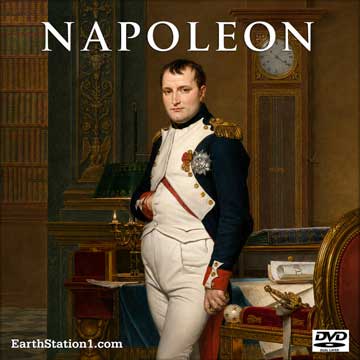
August 20, 1882: Aesthetics: Performing
Arts: Premieres: Theatre Premieres: Musical Premieres: Symphony
Premieres: -- Pyotr Ilyich Tchaikovsky's 1812 Solemn Overture, Op.
49, popularly known as the 1812 Overture, written to commemorate
the successful Russian defense in 1812 against Napoleon's invading
Grande Armee during The French Invasion Of Russia (known in Russia
as The Patriotic War Of 1812, and in France as The Russian
Campaign), premieres in Moscow, Russia, conducted by Ippolit
Al'tani under a tent near the then-unfinished Cathedral Of Christ
The Saviour, which also memorialized the 1812 defense of Russia.
Tchaikovsky himself conducted another performance at the
dedication of Carnegie Hall in New York City, one of the first
times a major European composer visited the United States. The
15-minute overture is best known for its climactic volley of
cannon fire, ringing chimes, and a brass fanfare finale. It has
also become a common accompaniment to fireworks displays on the
United States' Independence Day. The 1812 Overture went on to
become one of Tchaikovsky's most popular works, along with his
ballet scores to The Nutcracker, The Sleeping Beauty, and Swan
Lake. On Sale Until Midnight Tonight PT!
https://store.earthstation1.com/napoleon-bonaparte-documentaries-collection-mp4-video-download-dv4.html
Today's
EarthStation1.com 15% (Or More!) Off Commemorative Memorial Title:
Jack Benny Presents Golden Memories Of Radio LPs CD, MP3 Download,
USB
Today, August 20, 2026
August 20, 1938: Sports: The History Of
Sports: The History Of Sports In The United States: The History Of
Baseball: The History Of Baseball In The United States: The
History Of Major League Baseball: Major League Baseball Records
(MLB Records): -- Lou Gehrig hits his 23rd career grand slam (a
home run hit with all three bases occupied by baserunners), a
record that stood for 75 years until it was broken by Alex
Rodriguez. Henry Louis Gehrig (born Heinrich Ludwig Gehrig; June
19, 1903 - June 2, 1941) was an American professional baseball
first baseman who played 17 seasons in Major League Baseball (MLB)
for the New York Yankees (1923-1939). Gehrig was renowned for his
prowess as a hitter and for his durability, which earned him his
nickname "The Iron Horse." He was an All-Star seven
consecutive times, a Triple Crown winner once, an American League
(AL) Most Valuable Player twice, and a member of six World Series
champion teams. He had a career .340 batting average, .632
slugging average, and a .447 on base average. He hit 493 home runs
and had 1,995 runs batted in (RBI). He still has the highest ratio
of runs scored plus runs batted in per 100 plate appearances
(35.08) and per 100 games (156.7) among Hall of Fame players. In
1939, he was elected to the Baseball Hall of Fame and was the
first MLB player to have his uniform number (4) retired by a team.
A native of New York City and a student at Columbia University,
Gehrig signed with the Yankees in 1923. He set several
major-league records during his career, including the most career
grand slams (23) (since broken by Alex Rodriguez) and most
consecutive games played (2,130), a record that stood for 56 years
and was long considered unbreakable until surpassed by Cal Ripken
Jr., in 1995. Gehrig's consecutive game streak ended on May 2,
1939, when he voluntarily took himself out of the lineup, stunning
both players and fans, after his performance on the field became
hampered by amyotrophic lateral sclerosis, an incurable
neuromuscular illness; it is now commonly referred to in North
America as "Lou Gehrig's disease". The disease forced
him to retire at age 36, and was the cause of his death two years
later. The pathos of his farewell from baseball was capped off by
his iconic 1939 "Luckiest Man on the Face of the Earth"
speech at Yankee Stadium. In 1969 the Baseball Writers'
Association of America voted Gehrig the greatest first baseman of
all time, and he was the leading vote-getter on the MLB
All-Century Team chosen by fans in 1999. A monument in Gehrig's
honor, originally dedicated by the Yankees in 1941, currently
resides in Monument Park at Yankee Stadium. The Lou Gehrig
Memorial Award is given annually to the MLB player who best
exhibits Gehrig's integrity and character. On Sale Until Midnight
Tonight PT!
https://store.earthstation1.com/jack-benny-presents-golden-memories-of-radio-6-album-set-mp3-63.html
Today's
EarthStation1.com 15% (Or More!) Off Commemorative Memorial Title:
Outer Space Films 9: Mars Probes DVD, Video Download, USB Flash
Drive
Today, August 20, 2026
August 20, 1975: Rocket Launches: The
History Of Rocketry: The History Of Spaceflight: The Aftermath Of
World War II: The Cold War: The Space Age: The Space Race: The
Discovery And Exploration Of The Solar System: Space Probes:
Interplanetary Space Probes: The United States Space Program:
Spacecraft Missions To Mars: The Viking Program: Viking 1: -- The
Viking Program: Viking 1, planetary probe that was the first
spacecraft to land successfully on Mars and perform its mission,
record holder for the longest Mars surface mission of 2307 days
(over 6.25 years) or 2245 sols until that record was broken by
Opportunity on May 19, 2010, is launched by NASA atop a Titan
III-Centaur rocket launch vehicle from Cape Canaveral Air Force
Station Space Launch Complex 41 at 21:22 UTC. Viking 1 was the
first of two spacecraft (along with Viking 2) sent to Mars as part
of NASA's Viking program. The Viking program consisted of a pair
of American space probes sent to Mars, Viking 1 and Viking 2. Each
spacecraft was composed of two main parts: an orbiter designed to
photograph the surface of Mars from orbit, and a lander designed
to study the planet from the surface. The orbiters also served as
communication relays for the landers once they touched down. The
Viking program grew from NASA's earlier, even more ambitious,
Voyager Mars program, which was not related to the successful
Voyager deep space probes of the late 1970s. Viking 1 was launched
on August 20, 1975, and the second craft, Viking 2, was launched
on September 9, 1975, both riding atop Titan III-E rockets with
Centaur upper stages. Viking 1 entered Mars orbit on June 19,
1976, with Viking 2 following suit on August 7. After orbiting
Mars for more than a month and returning images used for landing
site selection, the orbiters and landers detached; the landers
then entered the Martian atmosphere and soft-landed at the sites
that had been chosen. The Viking 1 lander touched down on the
surface of Mars on July 20, 1976, and was joined by the Viking 2
lander on September 3. The orbiters continued imaging and
performing other scientific operations from orbit while the
landers deployed instruments on the surface. The project cost
roughly 1 billion USD in 1970s dollars, equivalent to about 5
billion USD in 2016 dollars. The mission was considered successful
and is credited with helping to form most of the body of knowledge
about Mars through the late 1990s and early 2000s. On Sale Until
Midnight Tonight PT!
https://store.earthstation1.com/outer-space-films-9-mars-space-probe-projects-viking-amp-mariner-dv9.html
Today's
EarthStation1.com 15% (Or More!) Off Commemorative Memorial Title:
The Charlie Chaplin Carnival, Festival & Cavalcade DVD, MP4,
USB Drive
Today, August 20, 2026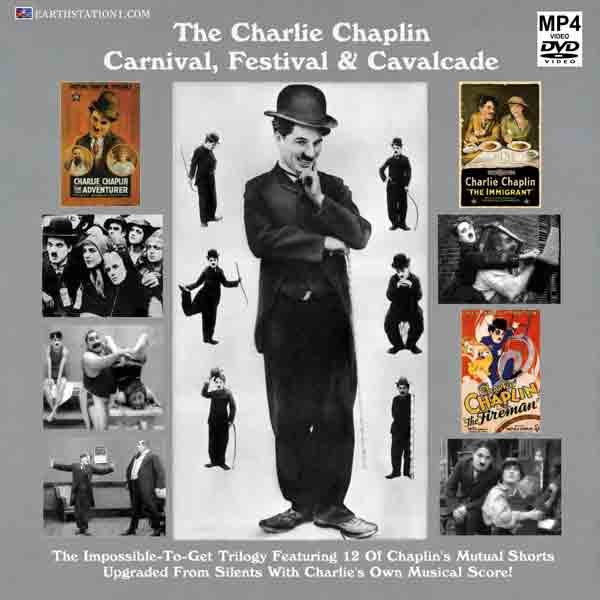
August 20, 1941: Aesthetics: Performing
Arts: Premieres: Film Premieres: American Film Premieres: --
Charlie Chaplin Cavalcade, a 1941 compilation film with sound of
silent movie shorts Chaplin made with the Mutual Film Corporation,
is released in the United States. Charlie Chaplin composed added a
musical score and added sound effects to this compilation of his
Mutual shorts "One A.M.", "The Rink", "The
Pawnshop", and "The Floorwalker", and retitled them
"Waiter And Skating Enthusiast / Pawnbroker's Assistant /
Impecunious Customer". On Sale Until Midnight Tonight PT!
https://store.earthstation1.com/the-charlie-chaplin-carnival-festival-and-cavalcade-dvd-12-sound-fil12.html
Today's
EarthStation1.com 15% (Or More!) Off Commemorative Memorial Title:
Heaven Man Earth: Kowloon Walled City The Hong Kong Triads DVD MP4
USB
Today, August 20, 2026
August 20, 1992: Film (Motion Pictures):
The History Of The Film Industry (The History Of The Motion
Picture Industry): The History Of The Chinese Film Industry (The
History Of The Chineses Motion Picture Industry): Crime: Crime In
China: Organized Crime: Organized Crime Triads: Kowloon Walled
City: -- Filming of the Hong Kong action crime thriller film Crime
Story which had begun six weeks prior on July 9, 1992 ends,
providing the last look inside Kowloon Walled City before its
demolition on March 23, 1993. Crime Story, also known as New
Police Story, released in the Philippines as Police Dragon, was
directed by Kirk Wong, and stars Jackie Chan, Kent Cheng, Law
Kar-ying and Puishan Au-yeung. The film was released in Hong Kong
on June 24, 1993, three months after the demolition of Kowloon
began. Unlike most Jackie Chan films, which feature a combination
of action and comedy, Crime Story is mostly a serious film. The
film is based on actual events surrounding the 1990 kidnapping of
Chinese businessman Teddy Wang, wealthy founder of the Chinachem
Group corporation. Kowloon Walled City was an ungoverned, densely
populated de jure Chinese enclave within the boundaries of Kowloon
City, Hong Kong. Originally a Chinese military fort, the walled
city became an enclave after the New Territories were leased to
the United Kingdom by China in 1898. Its population increased
dramatically following the Japanese occupation of Hong Kong during
World War II. By 1990, the walled city contained 50,000 residents
within its 2.6-hectare (6.4-acre) borders. From the 1950s to the
1970s, it was controlled by local triads and had high rates of
prostitution, gambling, and drug abuse. In January 1987, the Hong
Kong government announced plans to demolish the walled city. After
an arduous eviction process, and the transfer of de jure
sovereignty of the enclave from China to Britain, demolition began
in March 1993 and was completed in April 1994. Kowloon Walled City
Park opened in December 1995 and occupies the area of the former
walled city. Some historical artefacts from the walled city,
including its yamen building and remnants of its southern gate,
have been preserved there. On Sale Until Midnight Tonight PT!
https://store.earthstation1.com/heaven-man-earth-the-organized-crime-of-the-chinese-triads-dvd.html
Today's
EarthStation1.com 15% (Or More!) Off Commemorative Memorial Title:
Stalin: The Red Tsar TV Series + Soviet Assassins MP4 Download DVD
Set
Today, August 20, 2026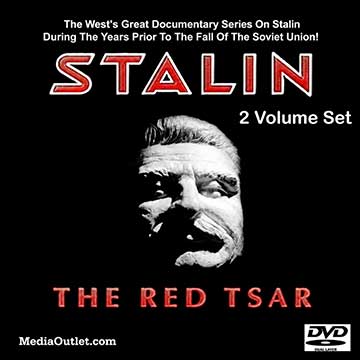
August 20, 1940: The Interwar Period (The
Interbellum, Between The Wars): The Soviet Union (The Union Of
Soviet Socialist Republics, USSR): The History Of The Soviet
Union: Mass Repression In The Soviet Union: Stalinism: The
Assassination Plots Of Joseph Stalin: Assassination Attempts On
Leon Trotsky: The Assassination Of Leon Trotsky: -- Leon Trotsky,
Russian revolutionary, Marxist theorist, and Soviet politician
whose particular strain of Marxist thought is known as Trotskyism
(November 7 [O.S. October 26] 1879 - August 21. 1940) is fatally
wounded while in exile in Mexico City, Mexico with an ice axe by
Ramon Mercader, a Spanish-born NKVD agent. Mercader acted upon
instruction from Stalin and was nearly beaten to death by
Trotsky's bodyguards, and spent the next 20 years in a Mexican
prison for the murder. Stalin presented Mercader with an Order of
Lenin in absentia. Trotsky died the next day. After an ineffectual
attempt to have Trotsky murdered in March 1939, Stalin assigned
the overall organization of implementing the task to the NKVD
officer Pavel Sudoplatov, who in turn co-opted Nahum Eitingon.
According to Sudoplatov's Special Tasks, the NKVD proceeded to set
up three NKVD agent networks to carry out the murder, one of which
relied on Ramon Mercader. According to Sudoplatov, all three
networks were designed to operate entirely autonomously from the
NKVD's hitherto-established spy networks in the U.S. and Mexico.
On 24 May 1940, Trotsky survived a raid on his villa by armed
assassins led by the NKVD agent Iosif Grigulevich and Mexican
painter David Alfaro Siqueiros. Trotsky's 14-year-old grandson,
Vsevolod Platonovich "Esteban" Volkov (born 7 March
1926), was shot in the foot, and a young assistant and bodyguard
of Trotsky, Robert Sheldon Harte, was abducted and later murdered.
Trotsky's other guards fended off the attackers. Following the
failed assassination attempt, Trotsky wrote an article titled
"Stalin Seeks My Death" on 8 June 1940, in which he
states that another assassination attempt is certain. On 20 August
1940, Trotsky was attacked in his study by Mercader, who used an
ice axe as a weapon. The blow to his head was bungled and failed
to kill Trotsky instantly. Witnesses stated that Trotsky spat on
Mercader and began struggling fiercely with him, which resulted in
Mercader's hand being broken. Hearing the commotion, Trotsky's
bodyguards burst into the room and nearly killed Mercader, but
Trotsky stopped them, laboriously stating that the assassin should
be made to answer questions. Trotsky was then taken to a hospital,
operated on, and survived for more than a day, dying at the age of
60 on 21 August 1940 from exsanguination and shock. Mercader later
testified at his trial: " I laid my raincoat on the table in
such a way as to be able to remove the ice axe which was in the
pocket. I decided not to miss the wonderful opportunity that
presented itself. The moment Trotsky began reading the article, he
gave me my chance; I took out the ice axe from the raincoat,
gripped it in my hand and, with my eyes closed, dealt him a
terrible blow on the head. According to James P. Cannon, the
secretary of the Socialist Workers Party (USA), Trotsky's last
words were "I will not survive this attack. Stalin has
finally accomplished the task he attempted unsuccessfully before."
Trotsky, born Lev Davidovich Bronstein, initially supported the
Menshevik Internationalists faction within the Russian Social
Democratic Labour Party. He then joined the Bolsheviks
("majority") just before the 1917 October Revolution,
immediately becoming a leader within the Communist Party. He would
go on to become one of the seven members of the first Politburo,
founded in 1917 to manage the Bolshevik Revolution. During the
early days of the Russian Soviet Federative Socialist Republic
(RSFSR) and the Soviet Union, he served first as People's
Commissar for Foreign Affairs and later as the founder and
commander of the Red Army, with the title of People's Commissar of
Military and Naval Affairs. He became a major figure in the
Bolshevik victory in the Russian Civil War (1918-1922). After
leading a failed struggle of the Left Opposition against the
policies and rise of Joseph Stalin in the 1920s and against the
increasing role of bureaucracy in the Soviet Union, Trotsky was
removed as Commissar for Military and Naval Affairs (January
1925), removed from the Politburo (October 1926), removed from the
Central Committee (October 1927), expelled from the Communist
Party (November 1927), exiled to Alma-Ata (January 1928), and
exiled from the Soviet Union (February 1929). As the head of the
Fourth International, Trotsky continued to oppose the Stalinist
bureaucracy in the Soviet Union while in exile. Trotsky's ideas
formed the basis of Trotskyism, a major school of Marxist thought
that opposes the theories of Stalinism. He was written out of the
history books under Stalin, and was one of the few Soviet
political figures who was not rehabilitated by the government
under Nikita Khrushchev in the 1950s. On Sale Until Midnight
Tonight PT!
https://store.earthstation1.com/stalin-the-red-tsar-dvd-complete-4-part-tv-series-2-dis42.html
Today's
EarthStation1.com 15% (Or More!) Off Commemorative Memorial Title:
The Unknown War: The Great Patriotic War Series WWII USSR DVD MP4
USB
Today, August 20, 2026
August 20, 1944: The European Civil War:
World War II: The Second European War (The European Theater Of
World War II): The Eastern Front Of World War II: The Great
Patriotic War (The German-Soviet War): World War II In Romania:
The Battle Of Romania: The Second Jassy-Kishinev Offensive (The
Jassy-Kishinev Offensive) (August 20-29, 1944): -- The Battle Of
Romania begins with The Second Jassy-Kishinev Offensive, an
offensive resulted in the encirclement and destruction of the
German forces, allowing the Soviet Army to resume its strategic
advance further into Eastern Europe and pressured Romania to
switch allegiance from the Axis powers to the Allies, a massive
defeat, which can be compared to the defeat at Stalingrad. The
Second Jassy-Kishinev Offensive is named after the two major
cities, Iasi ("Jassy") and Chisinau ("Kishinev"),
and was the staging area of a Soviet offensive against Axis forces
in Eastern Romania from August 20 to 29, 1944. The 2nd and 3rd
Ukrainian Fronts of the Red Army engaged Army Group South Ukraine,
which consisted of combined German and Romanian formations, in an
operation to reoccupy Bessarabia and destroy the Axis forces in
the region, opening the way into Romania and the Balkans. The
Battle Of Romania comprised several operations in or around
Romania in 1944 in which the Soviet Army defeated the combined
Axis forces of Germany and Romania. It forced Romania to change
sides, and the resultant Soviet and Romanian forces drove the
Germans back into Hungary. In the first stage (the Jassy-Kishinev
Offensive), the Soviet Army attacked into Romania from the
northeast, through the territory of present-day Moldova. This
attack, between 20 August and 29 August, was a Soviet victory. The
German Sixth Army was encircled by the initial Soviet onslaught
and was destroyed for the second time. On 23 August, King Michael
of Romania led a coup d'etat against Prime Minister Ion Antonescu;
the new government surrendered to the Allies and declared war on
Germany. (Romanian historian Florin Constantiniu claims this
shortened World War II in Europe by six months. The Axis front
collapsed. In the north, the German Eighth Army retreated to
Hungary with heavy losses. Elsewhere, many Germans were cut off
and captured, such as the large security and anti-aircraft force
posted at the Ploie?ti oil field. Other fragments of the German
forces fled toward Hungary as best they could, fighting the
Romanians and Soviet forces, which stormed through the Carpathian
Mountains. Several passes through the mountains were held by
Romanian troops. The Soviet victory in Romania caused Bulgaria to
withdraw from the Axis on 26 August, and allowed Soviet forces to
invade Bulgaria on 8 September. By 24 September, nearly all of
Romania was under Allied control. On Sale Until Midnight Tonight
PT!
https://store.earthstation1.com/the-unknown-war-complete-tv-series-soviet-union-wwii-10-dvd-s10.html
Today's
EarthStation1.com 15% (Or More!) Off Commemorative Memorial Title:
De Gaulle And France TV Series DVD, Video Download, USB Flash
Drive
Today, August 20, 2026
August 20, 1955: The Aftermath Of World
War II: The Cold War: The Decolonisation Of Africa: The Algerian
War (The Algerian Revolution, The Algerian War Of Independence):
The Battle Of Philippeville (The Philippeville Massacre, The
August Offensive): -- In one of the events of late August 1955 in
the Constantinois region considered to be a major turning point of
the Algerian War, Algerian insurgents of the National Liberation
Front {(FLN (Algeria)} and armed mobs launch a series of raids on
two rural settlements and kill 77 French nationals in the
Constantinois region of northeastern Algeria. The Battle Of
Philippeville centered on the Algerian town of Philippeville,
though the FLN also made attacks on surrounding areas. The raids,
which mostly took the form of ethnic riots, resulted in the
massacre, in extremely gruesome ways, of several dozens of
Pied-Noir (French: "Black Feet", people of European and
especially French origin, born in Algeria during French rule; so
named either for coal-sooted French sailors, black-booted French
soldiers, black-booted horseman, swamp-dirty settlers, and
popularly for trampling grapes to make wine). These massacres were
then followed by very brutal and blind reprisals by the French
army and Pieds-Noirs vigilantes, which resulted in the death of
several thousand native Algerians. On Sale Until Midnight Tonight
PT!
https://store.earthstation1.com/de-gaulle-and-france-3-part-tv-documentary-series-2-disc-dvd-s32.html
Today's
EarthStation1.com 15% (Or More!) Off Commemorative Memorial Title:
Armed Forces Radio Presents Jubilee! WWII Radio DVD, MP3 Download,
USB
Today, August 20, 2026
August 20, 1905: #BOTD: #HBD! Jack
Teagarden, American jazz singer, songwriter and trombonist (d.
January 15, 1964) is #born Weldon Leo Teagarden in Vernon, Texas.
Teagarden was the preeminent American jazz trombone player before
the bebop era of the 1940s, and one of jazz's best singers.
Teagarden's early career was as a sideman with the likes of Paul
Whiteman and close lifelong friend Louis Armstrong. Teagarden's
trombone style was largely self-taught, and he developed many
unusual alternative positions and novel special effects on the
instrument. He is generally considered the most innovative jazz
trombone stylist of the pre-bebop era. Jazz clarinetist Pee Wee
Russell called him "the best trombone player in the world".
By 1920, Teagarden was playing professionally in San Antonio,
including with the band of pianist Peck Kelley. In the mid-1920s
he started traveling widely around the United States in a quick
succession of different bands. In 1927, he went to New York City
where he worked with several bands. By 1928 he played for the Ben
Pollack band. In the late 1920s, he recorded with such bandleaders
and sidemen as Armstrong, Benny Goodman, Bix Beiderbecke, Red
Nichols, Jimmy McPartland, Mezz Mezzrow, Glenn Miller, Eddie
Condon, and Fats Waller. In 1931, Teagarden's early orchestra
recorded the tune "Chances Are" with Fats Waller playing
piano and Jack singing and playing trombone. Miller and Teagarden
collaborated to provide lyrics and a verse to Spencer Williams'
"Basin Street Blues", which in that amended form became
one of the numbers that Teagarden played until the end of his
days. Teagarden sought financial security during the Great
Depression and signed an exclusive contract to play for the Paul
Whiteman Orchestra from 1933 through 1938. In 1946, Teagarden
joined Louis Armstrong's All Stars. In late 1951, Teagarden left
to again lead his own band. He died in New Orleans at the age of
58, suffering from pneumonia. He is buried at Forest Lawn Memorial
Park in Hollywood Hills, Los Angeles County, California. On Sale
Until Midnight Tonight PT!
https://store.earthstation1.com/armed-forces-radio-presents-jubilee-otr-jazz-music-mp3-dv3.html
Today's
EarthStation1.com 15% (Or More!) Off Commemorative Memorial Title:
The Golden Age Of Rock 'N' Roll DVD, MP4 Video Download, Flash
Drive
Today, August 20, 2026
August 20, 1942: #BOTD: #HBD! Isaac
Hayes, African American singer, actor, songwriter, and composer
(d. August 10, 2008) is #born Isaac Lee Hayes Jr. in Covington,
Tennessee. He was one of the creative forces behind the Southern
soul music label Stax Records, where he served both as an in-house
songwriter and as a session musician and record producer, teaming
with his partner David Porter during the mid-1960s to write a
string of smash hits, including "Soul Man" and "Hold
On, I'm Comin'". Hayes and Porter were inducted into the
Songwriters Hall of Fame in 2005 in recognition of writing scores
of songs for themselves, the duo Sam & Dave, Carla Thomas, and
others. In 2002, Hayes was inducted into the Rock and Roll Hall of
Fame. "Soul Man", written by Hayes and Porter and first
performed by Sam & Dave, was recognized as one of the most
influential songs of the past 50 years by the Grammy Hall of Fame.
It was also honored by The Rock and Roll Hall of Fame, by Rolling
Stone magazine, and by the Recording Industry Association of
America (RIAA) as one of the Songs of the Century. During the late
1960s, Hayes also began a career as a recording artist. He had
several successful soul albums such as Hot Buttered Soul (1969)
and Black Moses (1971). In addition to his work in popular music,
he worked as a composer of musical scores for motion pictures.
Hayes was known for his musical score for the film Shaft (1971).
For the "Theme from Shaft", he was awarded the Academy
Award for Best Original Song in 1972. This made him the third
black person, after Hattie McDaniel and Sidney Poitier, to win an
Academy Award in any competitive field covered by the Academy Of
Motion Picture Arts And Sciences. Hayes also won two Grammy Awards
for that same year. Later, he was given his third Grammy for his
music album Black Moses. In 1992, Hayes was crowned honorary king
of the Ada region of Ghana in recognition of his humanitarian work
there. He acted in motion pictures and television, such as in the
movies Truck Turner and I'm Gonna Git You Sucka, and as Gandolf
"Gandy" Fitch in the TV series The Rockford Files
(1974-1980). He voiced the character Chef from the animated Comedy
Central series South Park from its 1997 debut until his
controversial departure in 2006. On August 5, 2003, Hayes was
honored as a BMI Icon at the 2003 BMI Urban Awards for his
enduring influence on generations of music makers. Throughout his
songwriting career, Hayes received five BMI R & B Awards, two
BMI Pop Awards, two BMI Urban Awards and six Million-Air
citations. As of 2008, his songs had generated more than 12
million performances. Isaac Hayes died of a stroke while
exercising on an electric treadmill at his home in Memphis,
Tennessee, aged 65. He was buried at Memorial Park Cemetery, in
Memphis, Tennessee. The Tennessee General Assembly enacted
legislation in 2010 to honor Hayes by naming a section of
Interstate 40 the "Isaac Hayes Memorial Highway". The
name was applied to the stretch of highway in Shelby County from
Sam Cooper Boulevard in Memphis east to the Fayette County line.
The naming was made official at a 2010 ceremony held on Hayes's
birth anniversary, August 20. On Sale Until Midnight Tonight PT!
https://store.earthstation1.com/the-golden-age-of-rock-39n39-roll-dvd-complete-tv-series-5-39395.html
Today's
EarthStation1.com 15% (Or More!) Off Commemorative Memorial Title:
WABC Radio Airchecks MP3 Collection 1960s-1980s DVD, MP3 Download,
USB
Today, August 20, 2026
August 20, 1947: #BOTD: #HBD! James
Pankow, trombone player, songwriter and founding member of
Chicago, is #born James Carter Pankow in St. Louis, Missouri into
a family of German and Irish descent, one of nine siblings, the
older brother of actor John Pankow, who appeared on the TV series
Mad About You. The family moved to Park Ridge, Illinois when he
was eight years old. Pankow was influenced by his musician father,
Wayne. He started playing the trombone at St. Paul of the Cross
Elementary School. His Notre Dame High School band instructor was
Father George Wiskirchen, CSC. Pankow earned a full music
scholarship to Quincy College, where he studied the bass trombone.
After completing his first year, he returned home for the summer
and formed a band that began to play some live local shows. Not
wanting to give up this work, Pankow transferred to DePaul
University. He is a member of Phi Mu Alpha Sinfonia, and he was
given the National Citation as well as recognition as Signature
Sinfonian along with fellow Chicago members and Sinfonians on
August 26, 2009. At DePaul, Pankow met Walter Parazaider, who
recruited him to join a band, The Big Thing, which would become
Chicago Transit Authority. Soon after the first album's release,
the band's name was shortened to Chicago. Pankow has remained a
member of Chicago since its inception. In addition to playing the
trombone, Pankow has composed many songs for Chicago, including
the hits "Make Me Smile" and "Colour My World"
(both from his suite Ballet for a Girl in Buchannon), "Just
You 'N' Me," "(I've Been) Searchin' So Long," "Old
Days," "Alive Again," and (with Peter Cetera)
"Feelin' Stronger Every Day." Pankow has scored most of
Chicago's brass arrangements. Although he is not one of the band's
principal vocalists, he sang lead vocals for two Chicago songs:
"You Are On My Mind" (from Chicago X, 1976) and "Till
the End of Time" (Chicago XI, 1977). Along with fellow
Chicago horns Lee Loughnane and Walter Parazaider, Pankow was
featured on Three Dog Night's 1969 #15 hit "Celebrate"
and on several tracks of the 1979 Bee Gees' Spirits Having Flown
album. Pankow has appeared on several albums for the rock band
Toto, including the 1982 Grammy Award-winning Toto IV and their
2006 album Falling in Between, for which he composed the brass
arrangements and performed on the song "Dying on My Feet".
Pankow and his first wife Karen were married for 18 years. Their
children are Jonathan (born 1981) and Sarah (born 1986). Pankow
and his second wife Jeanne Pacelli have two children, Carter (born
1999) and Lilli (born 2002). On Sale Until Midnight Tonight PT!
https://store.earthstation1.com/wabc-musicradio-shows-mp3-dvd-60s80s-am-360807775.html
Today's
EarthStation1.com 15% (Or More!) Off Commemorative Memorial Title:
Led Zeppelin Reunion Atlantic Records 40th Anniversary DVD, MP4,
USB
Today, August 20, 2026
August 20, 1948: #BOTD: #HBD! Robert
Plant, English singer, songwriter, and musician, best known as the
lead singer and lyricist of the rock band Led Zeppelin. is #born
Robert Anthony Plant in the Black Country town of West Bromwich,
Staffordshire, England, to Robert C. Plant, a qualified civil
engineer who worked in the Royal Air Force during the Second World
War, and Annie Celia Plant (nee Cain), a Romani woman. Robert
Anthony Plant CBE ((C)ommander Of The Most Excellent Order Of the
(B)ritish (E)mpire). A powerful and wide vocal range (particularly
evident in his high-pitched vocals) has given him a successful
singing career spanning over 50 years. Plant is regarded as one of
the greatest singers in the history of rock and roll; he has
influenced fellow rock singer-songwriters such as Freddie Mercury,
Axl Rose and Chris Cornell. In 2006, Heavy Metal magazine Hit
Parader named Plant the "Greatest Metal Vocalist of All
Time". In 2009, Plant was voted "the greatest voice in
rock" in a poll conducted by Planet Rock. In 2008, Rolling
Stone editors ranked him number 15 on their list of the 100 best
singers of all time. In 2011, Rolling Stone readers ranked Plant
the greatest of all lead singers. On Sale Until Midnight Tonight
PT!
https://store.earthstation1.com/led-zeppelin-reunion-dvd-atlantic-records-40th-anniversary-sh40.html
Today's
EarthStation1.com 15% (Or More!) Off Commemorative Memorial Title:
DJ Madness! 1950s-60s-70s Radio Shows DVD, MP3 Download, USB Drive
Today, August 20, 2026
August 20, 1952: #BOTD: #HBD! Doug
Fieger, American singer, songwriter and guitarist, rhythm
guitarist and lead vocalist of the rock band The Knack who
co-wrote "My Sharona," the biggest hit song of 1979 in
the U.S., with lead guitarist Berton Averre (d. February 14, 2010)
is #born Douglas Lars Fiege in Oak Park, Michigan, the son of June
Beth (nee Oberer) and Bernard Julian Fieger. His father was Jewish
and his mother was Norwegian. Doug was the younger brother of
Detroit attorney Geoffrey Fieger (most famous for representing
Jack Kevorkian), who confirmed Doug's death to The Detroit News.
"My Sharona" spent six straight weeks at No. 1 on
Billboard's Hot 100 in 1979. It was the biggest hit of the year.
Fifteen years later the track gained renewed interest when it was
featured in the film Reality Bites. It was also featured regularly
in a Saturday Night Live skit parodying Janet Reno. The follow-up
hit to "My Sharona," "Good Girls Don't,"
stopped a notch short of the Top 10, peaking at No. 11. Their
album Get The Knack spent five straight weeks at No. 1. Three
million copies were sold in the United States and 6 million sold
worldwide. Doug Fieger died of cancer at his home in Woodland
Hills, Los Angeles, California, aged 57. His remains were
cremated; the final disposition of his ashes are not publicly
disclosed other than that they were given to family or friend(s).
Fieger wrote "My Sharona" for Sharona Alperin, his
not-yet girlfriend. Fieger and Alperin dated for four years, but
they parted, married other people, and remained friends. Alperin
visited him frequently in his final months. "People that
meant so much to him in the music industry came to pay their
respects to him," she said. "It was really beautiful."
On Sale Until Midnight Tonight PT!
https://store.earthstation1.com/dj-radio-airchecks-mp3-dvd-1950s60s70s-dis319506070.html
Today's
EarthStation1.com #OnThisDay Commemorative Memorial Title:
Communism With Tanks: Hungarian & East Bloc Revolutions DVD,
MP4, USB
Today, August 20, 2026 August 20: State Foundation Day (St.
Stephen's Day) (Hungary): -- August 20, 1000: Hungary: The History
Of Hungary: -- The Hungarian state is founded by Stephen Arpad,
later known as Saint Stephen, the first King of Hungary as Stephen
I. Celebrated as a National Day in Hungary, the day celebrates the
not only the country's founding day but also the numerous people
and events that helped create Hungary as we know it today.
Fireworks, ceremonies, and flags abound. But what are the origins
of this holiday? Depending on who you speak with, there could be
numerous interpretations and multiple meanings for people in
Hungary. You will find that people generally commemorate it as
State Foundation Day. The story begins with St. Stephen - the
first state founder and Hungarian king. After he died in 1038, St.
Stephen became the first canonized saint. His reign marked an era
of transformation in Hungary as the people converted to
Christianity under his leadership; he believed it would strengthen
Hungarian identity and pride. For these reasons and more, St.
Stephen is considered the founder of Hungary. On the same date,
August 20, 1083, Stephen I of Hungary, his son Emeric and
Hungary's Bishop Of Csanad Gerard Sagredo were canonized as saints
by Pope Gregory VII, himself a saint.
https://store.earthstation1.com/communism-with-tanks-dvd-hungarian-east-bloc-revolutions.html
Today's
EarthStation1.com #OnThisDay Commemorative Memorial Title: WWI: A
History In Pictures World War I JPG Photos CD, Download, USB
Today, August 20, 2026( #JCKaelin here: When I was a wee lad, I
told my family that when I grew up, I wanted to be an ambulance
driver. Now they have their own day - an international one, even!
:) ) ========= August 20: International Day Of Medical
Transporters (International Day Of Ambulance Drivers): -- A day to
honor ambulance drivers and the important work they do. The day
also encourages us to learn more about the job of a medical
transporter. A medical transporter has the important job of
getting a sick or injured person to a hospital, and they work in
high-stress situations. Sometimes getting their patient to the
hospital is a matter of life or death. Patients with traumatic
injuries most commonly receive medical transport. Other reasons
include patients who have abdominal pain, respiratory distress,
chest pain, loss of consciousness, or a seizure. In addition, in
some cases, patients with a behavioral disorders, such as violent
outbursts and other kinds of psychiatric problems receive medical
transport. Unfortunately, it's not uncommon for medical
transporters to get physically assaulted in these types of
scenarios.As part of their job, medical transporters also do the
following: Offer comfort and support to patients; Respond to 911
and other emergency calls; Lift patients in and out of bed;
Establish communication with patients; Maintain a secure and
healthy work environment; Respect patient confidentiality; Move
deceased patients and their belongings to the mortuary. Medical
transporters must be able to lift at least 50 pounds. They also
need to know CPR and operate different types of medical equipment,
such as an automated external defibrillator (AED). Other names for
a medical transporter include ambulance driver and emergency
medical services (EMS) provider. Many people also call them the
unsung heroes of everyday life.
https://store.earthstation1.com/wwi-a-history-in-pictures-world-war-i-photo-cd.html
Today's
EarthStation1.com #OnThisDay Commemorative Memorial Title: The
Divided Union: American Civil War TV Series DVD, MP4, USB Drive
Today, August 20, 2026August 20, 1866: The American Civil War
(The Civil War, The War Between The States): The Reconstruction
Era (Reconstruction): The Conclusion Of The American Civil War: --
President Andrew Johnson formally declares the American Civil War
over, some sixteen months after Confederate General in Chief
Robert E. Lee and his Army Of Northern Virginia surrendered to the
Union Army Of The Potomac under the Commanding General Of The
United States Army, Ulysses S. Grant. The conclusion of the
American Civil War commenced with the articles of surrender
agreement of the Army of Northern Virginia on April 9, at
Appomattox Court House, by General Robert E. Lee and concluded
with the surrender of the CSS Shenandoah on November 6, 1865,
bringing the hostilities of the American Civil War to a close.
Legally, the war did not end until a proclamation by President
Andrew Johnson on August 20, 1866, when he declared "that the
said insurrection is at an end and that peace, order,
tranquillity, and civil authority now exist in and throughout the
whole of the United States of America." Lee's defeat on April
9 began the effective end of the war, after which there was no
substantial resistance, but the news of his surrender took time to
spread and some fighting continued, though only small skirmishes.
President Abraham Lincoln lived to see Lee's surrender after four
bloody years of war, but he was assassinated just five days later.
The Battle of Columbus, Georgia, was fought on April 16, the day
after Lincoln died. For the most part though, news of Lee's defeat
led to a wave of Confederate surrenders. Gen. Joseph E. Johnston
surrendered his large Army of Tennessee and the Southeastern
Department on April 26. The Confederate cabinet was dissolved on
May 5, and Confederate President Jefferson Davis was captured by
Union soldiers on May 10, one day after Lincoln's successor,
Andrew Johnson, declared that the belligerent rights of the
Confederacy were at an end, with the rebellion effectively over.
The last battle of the war was fought at Palmito Ranch on May
12-13. The last large Confederate military department, the
Trans-Mississippi Department, surrendered on May 26, completing
the formalities on June 2. The last surrender on land did not come
until June 23, when Cherokee Confederate General Stand Watie gave
up his command. At sea, the last Confederate ship, CSS Shenandoah,
did not surrender until November 6. It had continued sailing
around the world raiding vessels until it finally received news of
the end of the war. Shenandoah also fired the last shots of the
war on June 22. By April 6, 1866, the rebellion was declared over
in all states but Texas. Finally, on August 20, 1866, the war was
declared legally over, though fighting had been over for more than
a year by then. The end of slavery in the United States of America
is closely tied to the end of the Civil War. As the main cause of
the war, slavery led to Lincoln's Emancipation Proclamation,
freeing slaves in the Confederacy as the Union advanced. The last
slaves in the Confederacy were not freed until June 19, 1865, now
celebrated as the national holiday Juneteenth. After the end of
hostilities, the war-torn nation then entered the Reconstruction
era in a partially successful attempt to rebuild the country and
grant civil rights to freed slaves. The American Civil War was a
civil war in the United States from 1861 to 1865, fought between
northern states loyal to the Union and southern states that had
seceded to form the Confederate States of America. The principal
cause of the war was the status of slavery in the United States,
especially in the territories. After Abraham Lincoln won the
November 1860 presidential election on an anti-slavery platform,
an initial seven slave states declared their secession from the
country to form the Confederacy. War broke out in April 1861 when
secessionist forces attacked Fort Sumter in South Carolina, just
over a month after Lincoln's inauguration. An additional four
slave states joined the Confederacy in the following two months.
The Confederacy grew to control at least a majority of territory
in those eleven states (out of the 34 U.S. states in February
1861), and it claimed the additional states of Kentucky and
Missouri by assertions from native secessionists fleeing Union
authority. These states were given full representation in the
Confederate Congress throughout the Civil War. The two remaining
slave states, Delaware and Maryland, were invited to join the
Confederacy, but Delaware declined and nothing substantial
developed in Maryland due to intervention by federal troops. The
Confederate states were never diplomatically recognized as a joint
entity by the government of the United States, nor by that of any
foreign country. The states that remained loyal to the U.S. were
known as the Union. The Union and the Confederacy quickly raised
volunteer and conscription armies that fought mostly in the South
for four years. Intense combat left between 620,000 and 750,000
soldiers dead, along with an undetermined number of civilians. The
Civil War remains the deadliest military conflict in American
history, and accounted for more American military deaths than all
other wars combined until the Vietnam War. The war effectively
ended on April 9, 1865, when Confederate General Robert E. Lee
surrendered to Union General Ulysses S. Grant at the Battle of
Appomattox Court House. Confederate generals throughout the
Southern states followed suit, the last surrender on land
occurring on June 23. Much of the South's infrastructure was
destroyed, especially its railroads. The Confederacy collapsed,
slavery was abolished, and four million enslaved Black people were
freed. The war-torn nation then entered the Reconstruction era in
a partially successful attempt to rebuild the country and grant
civil rights to freed slaves. The Civil War is one of the most
studied and written about episodes in U.S. history, and remains
the subject of cultural and historiographical debate. Of
particular interest are the causes of the Civil War and the
persisting myth of the Lost Cause of the Confederacy. The American
Civil War was among the earliest industrial wars. Railroads, the
telegraph, steamships and iron-clad ships, and mass-produced
weapons were employed extensively. The mobilization of civilian
factories, mines, shipyards, banks, transportation, and food
supplies all foreshadowed the impact of industrialization in World
War I, World War II, and subsequent conflicts.
https://store.earthstation1.com/the-divided-union-american-civil-war-tv-series-3-dual-layer-dvd3.html
Today's
EarthStation1.com #OnThisDay Commemorative Memorial Title: The
Secret Of The Templars Series + Bonus Title MP4 Video Download DVD
Today, August 20, 2026August 20, 1308: Religion: The History Of
Religion: Abrahamic Religions: Christianity: The Catholic Church
(The Roman Catholic Church): Military Orders: The Knights Templar
(The Poor Fellow-Soldiers Of Christ And Of The Temple Of Solomon):
Arrests, Charges And Dissolution Of The Knights Templar: The
Pardon And Absolution Of Jacques De Molay: -- Pope Clement V
pardons Jacques de Molay, the last Grand Master of the Knights
Templar, absolving him of charges of heresy on the basis of de
Molay's confession under torture to commiting heresy. When Molay
later retracted his confession, Philip had him burned upon a
scaffold on an island in the River Seine in front of Notre-Dame de
Paris in March, 1314. Both the sudden end of the centuries-old
order of Templars and the dramatic execution of its last leader
turned Molay into a legendary figure. Jacques de Molay (c.
1240-1250 - March 18, 1314), also spelled "Molai", was
the 23rd and last grand master of the Knights Templar, leading the
order sometime before April 20, 1292 until it was dissolved by
order of Pope Clement V in 1312. Though little is known of his
actual life and deeds except for his last years as Grand Master,
he is one of the best known Templars. Jacques de Molay's goal as
grand master was to reform the order, and adjust it to the
situation in the Holy Land during the waning days of the Crusades.
As European support for the Crusades had dwindled, other forces
were at work which sought to disband the order and claim the
wealth of the Templars as their own. King Philip IV of France,
deeply in debt to the Templars, had Molay and many other French
Templars arrested in 1307 and tortured into making false
confessions. https://store.earthstation1.com/seofteseboti.html
Today's
EarthStation1.com #OnThisDay Commemorative Memorial Title: The
Guns Of August (1964) WWI Film DVD, Video Download, USB Drive
Today, August 20, 2026August 20, 1914:The European Civil War:
World War I: The First European War (The European Theater Of World
War I): The Guns Of August: The German Invasion Of Belgium (1914):
-- Brussels, the Belgian capital, is captured by the Germans. King
Albert, who as prescribed by the Belgian constitution took
personal command of the Belgian army, held the Germans off long
enough for Britain and France to prepare for the Battle Of The
Marne (6-9 September 1914) and continued to fight the Germans for
the remainder of the war. Albert led his army through the Siege Of
Antwerp and the Battle of the Yser until October 31 (Halloween)
1914, when the Belgian army was driven back to a last, tiny strip
of Belgian territory near the North Sea. Here the Belgians, in
collaboration with the armies of the Triple Entente, took up a war
of position, in the trenches behind the River Yser, remaining
there for the next four years. During this period, King Albert
fought alongside his troops and shared their dangers, while his
wife, Queen Elisabeth, worked as a nurse at the front. During his
time on the front, rumors spread on both sides of the lines that
the German soldiers never fired upon him out of respect for him
being the highest ranked commander in harm's way, while others
feared risking punishment by the Kaiser himself, who was his
cousin. The king also allowed his 14-year-old son, Prince Leopold,
to enlist in the Belgian army as a private and fight in the ranks.
The German Invasion Of Belgium was a military campaign which began
on 4 August 1914. Earlier, on 24 July, the Belgian government had
announced that if war came it would uphold its historic
neutrality. The Belgian government mobilised its armed forces on
31 July and a state of heightened alert (Kriegsgefahr) was
proclaimed in Germany. On 2 August, the German government sent an
ultimatum to Belgium, demanding passage through the country and
German forces invaded Luxembourg. Two days later, the Belgian
Government refused the demands and the British Government
guaranteed military support to Belgium. The German government
declared war on Belgium on 4 August, troops crossed the border and
began the Battle Of Liege. German military operations in Belgium
were intended to bring the 1st, 2nd and 3rd armies into positions
in Belgium from which they could invade France, which after the
fall of Liege on 7 August, led to sieges of Belgian fortresses
along the Meuse river at Namur and the surrender of the last forts
(16-17 August). The government abandoned the capital, Brussels, on
17 August and after fighting on the Gete river, the Belgian field
army withdrew westwards to the National Redoubt at Antwerp on 19
August. Brussels was occupied the following day and the Siege of
Namur began on 21 August. After the Battle Of Mons and the Battle
Of Charleroi, the bulk of the German armies marched south into
France, leaving small forces to garrison Brussels and the Belgian
railways. The III Reserve Corps advanced to the fortified zone
around Antwerp and a division of the IV Reserve Corps took over in
Brussels. The Belgian field army made several sorties from Antwerp
in late August and September to harass German communications and
to assist the French and the British Expeditionary Force (BEF), by
keeping German troops in Belgium. German troop withdrawals to
reinforce the main armies in France were postponed to repulse a
Belgian sortie from 9 to 13 September and a German corps in
transit was retained in Belgium for several days. Belgian
resistance and German fear of francs-tireurs, led the Germans to
implement a policy of terror (schrecklichkeit) against Belgian
civilians soon after the invasion, in which massacres, executions,
hostage taking and the burning of towns and villages took place
and became known as the Rape of Belgium. By November 1914, most of
Belgium was under German occupation and Allied naval blockade. A
German military administration was established on 26 August 1914,
to rule through the pre-war Belgian administrative system,
overseen by a small group of German officers and officials.
Belgium was divided into administrative zones, the General
Government of Brussels and its hinterland; a second zone, under
the 4th Army, including Ghent and Antwerp and a third zone under
the German Navy along the coastline. The German occupation lasted
until late 1918.
https://store.earthstation1.com/the-guns-of-august-dvd-1964-world-war-i-movie-documen1964.html
Today's
EarthStation1.com #OnThisDay Commemorative Memorial Title: The
Gulf Crisis: The Road To War TV Series + Bonus 2 DVDs MP4 Download
Today, August 20, 2026August 20, 1990: The Aftermath Of World
War II: The Cold War: The Cold War (1985-1991) (The End Of The
Cold War): The Gulf War (The Persian Gulf War, Gulf War I): The
Invasion Of Kuwait: -- Following the United Nations Security
Council Resolution 664 (UNSCR 664), which recalled Iraq's
obligations under international law and demanded that Iraq permit
and facilitate the departure of nationals from third countries
from within Iraq and Kuwait, hundreds of thousands of Pakistani,
Egyptian, Palestinian, and Filipino guest workers flee Kuwait to
Jordan; nevertheless, 82 British nationals are taken hostage in
Kuwait, calling them "guests" but actually intended for
use as human shields at stratetic sites as insurance against
attacks by the growing coalition against Iraq. Thousands of
foreigners were in Iraq and Kuwait at the time of the Iraqi
invasion, and the Council denounced Iraq's decision to use foreign
nationals as human shields. Operation Desert Shield had been
officially launched on August 8, as the day before that President
George Bush ordered a massive military buildup to prevent further
Iraqi military advances, with the first American soldiers being
sent to Saudi Arabia that same day: 15,000 U.S. troops, 32
destroyers and 100 helicopters and fighter planes. Soon after his
conquest of Kuwait, Saddam began verbally attacking the Saudis. He
argued that the US-supported Saudi state was an illegitimate and
unworthy guardian of the holy cities of Mecca and Medina. He
combined the language of the Islamist groups that had recently
fought in Afghanistan with the rhetoric Iran had long used to
attack the Saudis. Acting on the Carter Doctrine's policy that the
United States would use military force, if necessary, to defend
its national interests in the Persian Gulf, and out of fear the
Iraqi Army could launch an invasion of Saudi Arabia, US President
George Bush quickly announced that the US would launch a "wholly
defensive" mission to prevent Iraq from invading Saudi Arabia
under the codename Operation Desert Shield. Operation Desert
Shield began on August 7, 1990 when US troops were sent to Saudi
Arabia due also to the request of its monarch, King Fahd, who had
earlier called for US military assistance. This "wholly
defensive" doctrine was quickly abandoned when, on August 8,
Iraq declared Kuwait to be Iraq's 19th province and Saddam named
his cousin, Ali Hassan Al-Majid, as its military-governor. The US
Navy dispatched two naval battle groups built around the aircraft
carriers USS Dwight D. Eisenhower and USS Independence to the
Persian Gulf, where they were ready by 8 August. The US also sent
the battleships USS Missouri and USS Wisconsin to the region. A
total of 48 US Air Force F-15s from the 1st Fighter Wing at
Langley Air Force Base, Virginia, landed in Saudi Arabia, and
immediately commenced round the clock air patrols of the
Saudi-Kuwait-Iraq border to discourage further Iraqi military
advances. They were joined by 36 F-15 A-Ds from the 36th Tactical
Fighter Wing at Bitburg, Germany. The Bitburg contingent was based
at Al Kharj Air Base, approximately an hour south east of Riyadh.
The 36th TFW would be responsible for 11 confirmed Iraqi Air Force
aircraft shot down during the war. There were also two Air
National Guard units stationed at Al Kharj Air Base, the South
Carolina Air National Guard's 169th Fighter Wing flew bombing
missions with 24 F-16s flying 2,000 combat missions and dropping 4
million pounds of munitions, and the New York Air National Guard's
174th Fighter Wing from Syracuse flew 24 F-16s on bombing
missions. Military buildup continued from there, eventually
reaching 543,000 troops, twice the number used in the 2003
invasion of Iraq. Much of the material was airlifted or carried to
the staging areas via fast sealift ships, allowing a quick
buildup.
https://store.earthstation1.com/the-gulf-crisis-the-road-to-war-tv-documentary-series-dvd-mp4-us4.html
Today's
EarthStation1.com #OnThisDay Commemorative Memorial Title: WWII
Films: African Americans At War Films Set DVD, MP4, USB Drive
Today, August 20, 2026August 20, 1948: #DOTD: #RIP: Howard
Wooten, African American Tuskegee Airman who long after his death
was memorialized by the U.S. Air Force when his World War II
pilots photograph was chosen by an advertising agency to represent
the famed Tuskegee Airmen in Air Force recruiting posters in the
1990s, a photo later adopted as the official image of the Tuskegee
Airmen Foundation, a National Archives photograph has also been
seen in public media including ESPN, Flight, Ebony, Sports
Illustrated, and other periodicals (b. April 20, 1920) #dies at
the age of 28 after a 70-foot fall from a scaffold while painting
the base the 12th Avenue Bridge to Beacon Hill, Seattle {now known
as the Jose Rizal Bridge, which carries 12th Avenue South over
South Dearborn Street and Interstate 90 in Seattle, connecting
Beacon Hill to the International District (now known as the
Chinatown-International District of Seattle, Washington (CID), the
center of the city's Asian American community, containing the
three neighborhoods known as Chinatown, Japantown and Little
Saigon)}. He is buried at Evergreen-Washelli Memorial Park in
Seattle, Washington. Howard Wooten was born Howard Adolphus Wooten
in Lovelady, Texas to Johnnie C. Morris Wooten and Howard L.
Wooten. His father was the principal of the colored school in
Lovelady, a town 100 miles north of Houston, and his mother also
was a teacher there. Howard A. Wooten grew up on a farm near
Lovelady and in 1937, at age 17, he entered Prairie View College
on a football scholarship. His main interest, however, was in
aviation and he attempted to enroll in flight training programs.
His father objected because he didnt think airplanes were safe and
because he wanted his son to finish college. Wooten dropped out of
Prairie View College in 1940 and enlisted in the U.S. Army as a
private assigned to a Field Artillery unit. He rose through the
ranks, becoming a Staff Sergeant in the 46th Field Artillery
Brigade by January 1942. Now 24, and no longer needing his parents
permission to enter flight training programs, he applied to the
Army Flight School at Tuskegee, Alabama in 1944 and graduated in
December of that year. After graduation he was assigned to the
15th USAAF Brigade as a fighter pilot, in the 332nd Fighter Group.
In January 1945 he was reassigned to the 477th Bombardment Group,
where he was one of a select group of Tuskegee pilots who would
train to fly North American B-25 Mitchell bombers. Wooten was
transferred to Mather Field, California for additional training.
Yet Wooten and the other men training on bombers would never see
combat, as the war ended before they were sent overseas. Wooten
was mustered out of the U.S. Army Air Corps in 1946. He then
decided to become an attorney and moved to Seattle, Washington
with four brothers and a sister, so as to get as far away as
possible from Jim Crow Texas. Soon after he arrived, he was hired
as a production worker at the Boeing Airplane Company and joined
the Aeronautical Machinists Union. While working on the assembly
line he met Josephine A. Stratman, another Boeing production
worker. They were married in 1947. In 1948 the Machinists Union
went on strike at Boeing. Because he and his wife had an infant,
Wooten joined the Painters Union and took work painting bridges
around Seattle.
https://store.earthstation1.com/wwii-films-africanamericans-at-war-dvd.html
Today's
EarthStation1.com #OnThisDay Commemorative Memorial Title: The
Yellowstone Fires Of 1988 Documentary DVD, Download, USB Drive
Today, August 20, 2026August 20, 1988: Natural Disasters:
Natural Disasters In The United States: Fires: Conflagrations:
Conflagrations In The United States: Wildfires (Forest Fires,
Bushfires, Brushfires, Wildland Fires, Rural Fires): The
Yellowstone Fires Of 1988: The Storm Creek Fire: -- The Storm
Creek Fire, which started on June 14 well north of the park in the
Absaroka-Beartooth Wilderness, and for almost two months seemed to
pose little threat to Yellowstone, begins on August 20 to move
rapidly to the south, also threatening the town of Cooke City,
this time from the north. An effort to bulldoze a wide fire break
and set backfires to try to starve the fires of combustibles
almost led to disaster when an unexpected change in wind direction
brought the fires to within a hundred yards of parts of the town,
forcing evacuations on September 6. The Yellowstone Fires Of 1988
collectively formed the largest wildfire in the recorded history
of Yellowstone National Park in the United States. Starting as
many smaller individual fires, the flames quickly spread out of
control due to drought conditions and increasing winds, combining
into one large conflagration which burned for several months. The
fires almost destroyed two major visitor destinations and, on
September 8, 1988, the entire park closed to all non-emergency
personnel for the first time in its history. Only the arrival of
cool and moist weather in the late autumn brought the fires to an
end. A total of 793,880 acres (3,213 km2), or 36 percent of the
park, was affected by the wildfires. Thousands of firefighters
fought the fires, assisted by dozens of helicopters and fixed-wing
aircraft which were used for water and fire retardant drops. At
the peak of the effort, more than 9,000 firefighters were assigned
to the park. With fires raging throughout the Greater Yellowstone
Ecosystem and other areas in the western United States, the
staffing levels of the National Park Service and other land
management agencies were inadequate for the situation; more than
4,000 U.S. military personnel were soon brought in to assist in
wildfire suppression efforts. The firefighting effort cost 120M
USD (260M USD in 2020). Losses to structures were minimized by
concentrating firefighting efforts near major visitor areas,
keeping property damage down to 3M USD (6M USD as of 2020). No
firefighters died while fighting the Yellowstone fires, though
there were two fire-related deaths outside the park. Before the
late 1960s, fires were generally believed to be detrimental for
parks and forests, and management policies were aimed at
suppressing fires as quickly as possible. However, as the
beneficial ecological role of fire became better understood in the
decades before 1988, a policy was adopted of allowing natural
fires to burn under controlled conditions, which proved highly
successful in reducing the area lost annually to wildfires. In
contrast, in 1988, Yellowstone was overdue for a large fire, and,
in the exceptionally dry summer, many smaller "controlled"
fires combined. The fires burned discontinuously, leaping from one
patch to another, leaving intervening areas untouched. Intense
fires swept through some regions, burning everything in their
paths. Tens of millions of trees and countless plants were killed
by the wildfires, and some regions were left looking blackened and
dead. However, more than half of the affected areas were burned by
ground fires, which did less damage to hardier tree species. Not
long after the fires ended, plant and tree species quickly
reestablished themselves, and native plant regeneration has been
highly successful. The Yellowstone Fires Of 1988 were
unprecedented in the history of the National Park Service, and led
to many questions about existing fire management policies. Media
accounts of mismanagement were often sensational and inaccurate,
sometimes wrongly reporting or implying that most of the park was
being destroyed. While there were temporary declines in air
quality during the fires, no adverse long-term health effects have
been recorded in the ecosystem and, contrary to initial reports,
few large mammals were killed by the fires, though there was a
subsequent reduction in the number of moose which has yet to
rebound.
https://store.earthstation1.com/the-yellowstone-fires-of-1988-documentary1988.html
Today's
EarthStation1.com #OnThisDay Commemorative Memorial Title:
Portraits Of American Presidents Nos. 1-42 TV Series MP4 Download
DVD
Today, August 20, 2026August 20, 1833: #BOTD: #HBD! Benjamin
Harrison, American soldier, politician, lawyer, 23rd president of
the United States from 1889 to 1893 (d. March 13, 1901) is #born
in North Bend, Ohio on a farm by the Ohio River. He was a grandson
of the ninth president, William Henry Harrison, creating the only
grandfather-grandson duo to have held the office. He was also a
great-grandson of Benjamin Harrison V, a founding father who
signed the United States Declaration Of Independence. Harrison
graduated from Miami University in Oxford, Ohio. After moving to
Indianapolis, he established himself as a prominent local
attorney, Presbyterian church leader, and politician in Indiana.
During the American Civil War, he served in the Union Army as a
colonel, and was confirmed by the U.S. Senate as a brevet
brigadier general of volunteers in 1865. Harrison unsuccessfully
ran for governor of Indiana in 1876. The Indiana General Assembly
elected Harrison to a six-year term in the U.S. Senate, where he
served from 1881 to 1887. A Republican, Harrison was elected to
the presidency in 1888, defeating the Democratic incumbent, Grover
Cleveland. Hallmarks of Harrison's administration included
unprecedented economic legislation, including the McKinley Tariff,
which imposed historic protective trade rates, and the Sherman
Antitrust Act. Harrison also facilitated the creation of the
national forest reserves through an amendment to the Land Revision
Act of 1891. During his administration six western states were
admitted to the Union: North Dakota, South Dakota, Montana,
Washington, Idaho and Wyoming, more states than have been admitted
any other presidency. In addition, Harrison substantially
strengthened and modernized the U.S. Navy and conducted an active
foreign policy, but his proposals to secure federal education
funding as well as voting rights enforcement for African Americans
were unsuccessful. Due in large part to surplus revenues from the
tariffs, federal spending reached one billion dollars for the
first time during his term. The spending issue in part led to the
defeat of the Republicans in the 1890 midterm elections. Cleveland
defeated Harrison for reelection in 1892, due to the growing
unpopularity of high tariffs and high federal spending. Harrison
returned to private life and his law practice in Indianapolis. In
1899 he represented the Republic of Venezuela in its British
Guiana boundary dispute with the United Kingdom. Harrison traveled
to the court of Paris as part of the case and after a brief stay
returned to Indianapolis. He died at his home in Indianapolis in
1901 of complications from influenza. He is buried at Crown Hill
Cemetery in Indianapolis, Indiana. Many have praised Harrison's
commitment to African Americans' voting rights, but scholars and
historians generally regard his administration as below average,
and rank him in the bottom half among U.S. presidents, though they
do not question his commitment to personal and official integrity.
https://store.earthstation1.com/portraits-of-american-presidents-nos-142-tv-series-mp4-download1424.html
Today's
EarthStation1.com #OnThisDay Commemorative Memorial Title: The
Legend Of Jewish Humor DVD, MP4 Download, USB Flash Drive
Today, August 20, 2026August 20, 1953: #BOTD: #HBD! Max
Alexander, American stand-up comedian and actor who appeared
numerous times on The Tonight Show (d. November 2, 2016) is #born
Michael Drelich in New York City. In addition to doing stand-up
comedy, Alexander also began appearing in supporting appearances
on many sitcoms (Full House) and other series (Matlock).
Alexander's film credits include supporting roles with stars such
as Tom Hanks, Steve Martin, Jim Carrey, and Jason Segel, in such
films as Roxanne (1987), Punchline (1988), and Forgetting Sarah
Marshall. He also appeared in Comedy Central's Best of the Improv,
Vol. 5 (2003) and Comedy Club Greats with Jerry Seinfeld (2007).
In recent years Alexander was frequently in Las Vegas, performing
his comedy alongside Tom Jones and others. His last film was
Trainwreck (2015). He entertained at the 1989 wedding of
Ann-Margret's son Lars, in Las Vegas, He appeared on the Jerry
Lewis MDA Telethon as well. His stand-up routine focused primarily
on his large size, constantly poking fun at his weight. He was
known for pulling his pants up to his chest during his routines.
In 2008, Alexander was hospitalized with a kidney ailment and
needed a transplant to survive. His brother Rabbi Moshe Drelich
was the one who donated it. A few weeks after his transplant,
Alexander suffered a stroke. Alexander died on November 2, 2016
from a form of throat cancer. He is buried at Eretz HaChaim
Cemetery in Beit Shemesh, Jerusalem District, Israel.
https://store.earthstation1.com/the-legend-of-jewish-comedy-dvd-mp4-download-usb-flash-driv4.html
Today's
EarthStation1.com #OnThisDay Commemorative Memorial Title: Classic
Baby Boomer Bloopers Video Collection DVD, Download, USB Drive
Today, August 20, 2026August 20, 2017: #DOTD: #RIP: Jerry
Lewis, American film pioneer, actor, comedian, singer, film
producer, film director and screenwriter, genius and jerk (b.
March 16, 1926) #dies of end-stage cardiac disease and peripheral
artery disease at his home in Las Vegas, Nevada at the age of 91.
In his will, Lewis left his estate to his second wife of 34 years,
SanDee Pitnick, and their adopted daughter. All of Lewis's
children and grandchildren from his marriage to Palmer were
excluded from inheriting any part of his estate. His eldest son,
Gary, the leader of Gary Lewis & the Playboys, publicly called
his father a "mean and evil person" and said that Lewis
never showed him or his siblings any love or care. His remains
were cremated, and the ashes given to his widow SanDee. Jerry
Lewis was born Jerome Levitch in Newark, New Jersey, to the Jewish
family of Daniel "Danny" Levitch (1902-1980), a master
of ceremonies and vaudevillian who performed under the stage name
Danny Lewis, from New York whose parents immigrated to the United
States from the Russian Empire, and Rachael "Rae"
Levitch (nee Brodsky; 1903-1983), a WOR pianist and Danny's music
director, from Warsaw, Poland. Reports as to his birth name are
conflicting; in Lewis' 1982 autobiography, he claimed his birth
name was Joseph, after his maternal grandfather, but his birth
certificate, the 1930 U. S. Census, and the 1940 U. S. Census all
name him as Jerome. Jerry Lewis is known for his slapstick humor
in film, television, stage and radio. He and Dean Martin were
partners as the hit popular comedy duo of Martin and Lewis.
Following that success, he was a solo star in motion pictures,
nightclubs, television shows, concerts, album recordings and
musicals. Lewis served as national chairman of the Muscular
Dystrophy Association and hosted the live Labor Day broadcast of
the Jerry Lewis MDA Telethon for 44 years. Lewis has received
several awards for lifetime achievements from the American Comedy
Awards, Los Angeles Film Critics Association, Venice Film
Festival, Academy Of Motion Picture Arts And Sciences and been
honored with two stars on the Hollywood Walk of Fame. Lewis wed
Patti Palmer (nee Esther Grace Calonico; 1921-2021), a singer with
Ted Fio Rito, on October 3, 1944. They had six sons together; five
biological: Gary (born 1945), Scott (born 1956), Christopher (born
1957), Anthony (born 1959) and Joseph (1964-2009); and one
adopted: Ronald (born 1949). It was an interfaith marriage; Lewis
was Jewish and Palmer was Catholic. He openly pursued
relationships with other women and gave unapologetic interviews
about his infidelity, revealing his affairs with Marilyn Monroe
and Marlene Dietrich to People in 2011. Palmer filed for divorce
from Lewis in 1980, after 35 years of marriage, citing Lewis's
extravagant spending and infidelity on his part, and it was
finalized in 1983. Lewis's second wife was Sandra "SanDee"
Pitnick, a University of North Carolina School of the Arts
professionally trained ballerina and stewardess, who met Lewis
after winning a bit part in a dancing scene on his film Hardly
Working. They wed on February 13, 1983, in Key Biscayne, Florida,
adopted a daughter, Danielle (born 1992), and were married for 34
years until Lewis' death.
https://store.earthstation1.com/classic-baby-boomer-bloopers-tv-amp-movie-blooper-outtakes-dvd.html
Today's
EarthStation1.com #OnThisDay Commemorative Memorial Title: The
American Adventure: TV History Series 1607-1876 DVD MP4 USB Drive
Today, August 20, 2026August 20, 1643: #DOTD: #RIP: Anne
Hutchinson, Puritan spiritual advisor, religious reformer, and an
important participant in the Antinomian Controversy which shook
the infant Massachusetts Bay Colony from 1636 to 1638 (b. July 20,
1591) #dies aged 52 in what is now Eastchester, Bronx, New York
when she, along with six of her children and other household
members, were killed by Siwanoys during Kieft's War, a conflict
between the colonial province of New Netherland and the Wappinger
and Lenape Indians in what is now New York and New Jersey. The
only survivor was her nine-year-old daughter Susanna, who was
taken captive. Her burial place is unknown; a cenotaph was erected
in April 1996 in Pelham Bay Park, The Bronx. Hutchinson is a key
figure in the history of religious freedom in England's American
colonies and the history of women in ministry, challenging the
authority of the ministers. She is honored by Massachusetts with a
State House monument calling her a "courageous exponent of
civil liberty and religious toleration". Anne Hutchinson was
born Anne Marbury in Alford, Lincolnshire, England, the daughter
of Francis Marbury, an Anglican cleric and school teacher who gave
her a far better education than most other girls received. Anne
Hutchinson had strong religious convictions that were at odds with
the established Puritan clergy in the Boston area. Her popularity
and charisma helped create a theological schism that threatened
the Puritan religious community in New England. On March 22, 1638,
Anne Hutchinson was banished from Massachusetts Bay Colony, along
with many of her supporters, after having been tried and convicted
for religious dissent, from the colony. She lived in London as a
young adult, and there married a friend from home, William
Hutchinson. The couple moved back to Alford where they began
following preacher John Cotton in the nearby port of Boston,
Lincolnshire. Cotton was compelled to emigrate in 1633, and the
Hutchinsons followed a year later with their 11 children and soon
became well established in the growing settlement of Boston in New
England. Hutchinson was a midwife and helpful to those needing her
assistance, as well as forthcoming with her personal religious
understandings. Soon she was hosting women at her house weekly,
providing commentary on recent sermons. These meetings became so
popular that she began offering meetings for men as well,
including the young governor of the colony, Henry Vane. Hutchinson
began to accuse the local ministers (except for Cotton and her
husband's brother-in-law, John Wheelwright) of preaching a
covenant of works rather than a covenant of grace, and many
ministers began to complain about her increasingly blatant
accusations, as well as certain unorthodox theological teachings.
The situation eventually erupted into what is commonly called the
Antinomian Controversy, culminating in her 1637 trial, conviction,
and banishment from the colony. This was followed by a March 1638
church trial in which she was put out of her congregation.
Hutchinson and many of her supporters established the settlement
of Portsmouth, Rhode Island with encouragement from Providence
Plantations founder Roger Williams in what became the Colony of
Rhode Island and Providence Plantations. After her husband's death
a few years later, threats of Massachusetts annexing Rhode Island
compelled Hutchinson to move totally outside the reach of Boston
into the lands of the Dutch. Five of her older surviving children
remained in New England or in England, while she settled with her
younger children near an ancient landmark, Split Rock, in what
later became The Bronx in New York City. Tensions were high at the
time with the Siwanoy Indian tribe.
https://store.earthstation1.com/the-american-adventure-series-us-1st-century-4-dv14.html